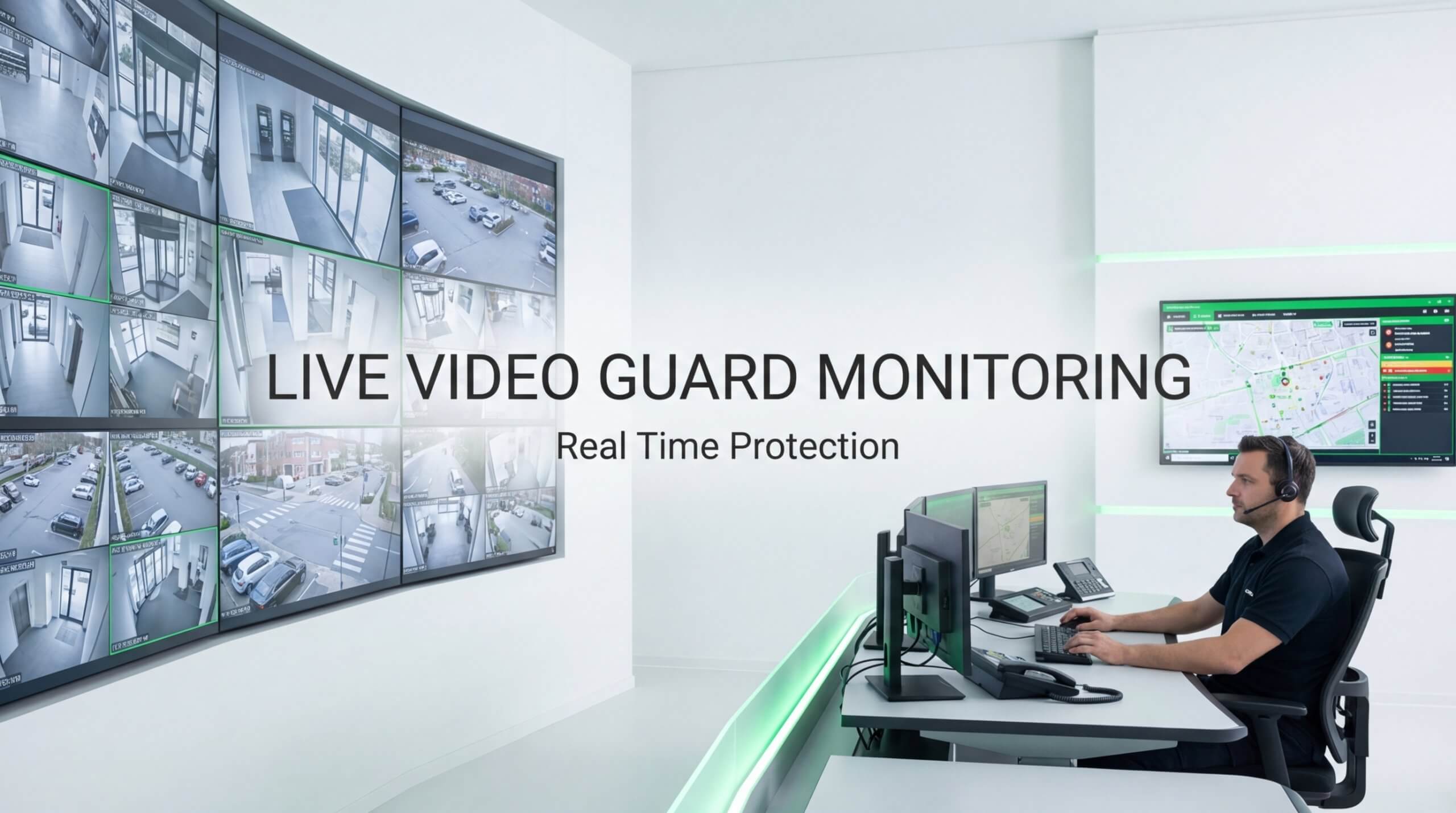
A live video guard is a trained security operator who monitors your property remotely through real-time video feeds, intervening the moment a threat appears. This stands in direct contrast to traditional CCTV, which records footage passively for review only after an incident has already occurred.
This guide covers how live video guard technology works, the measurable differences between active monitoring and passive CCTV, the limitations that make standard surveillance insufficient for many properties, the specific scenarios where live monitoring becomes essential, and how AI integration is reshaping the entire approach to video security.
Live video guard systems combine high-resolution IP cameras, AI-driven video analytics, and two-way audio into a single workflow where detection, verification, and response happen within seconds. When analytics flag suspicious activity, a remote operator can assess and intervene within 5 to 15 seconds through verbal warnings, siren activation, or direct law enforcement dispatch.
Traditional CCTV, commercially available since 1949, still operates on largely the same model: cameras record, footage gets stored, and someone reviews it after the fact. Operator fatigue, image quality gaps, and the complete absence of real-time intervention leave these systems functioning as silent witnesses rather than active deterrents.
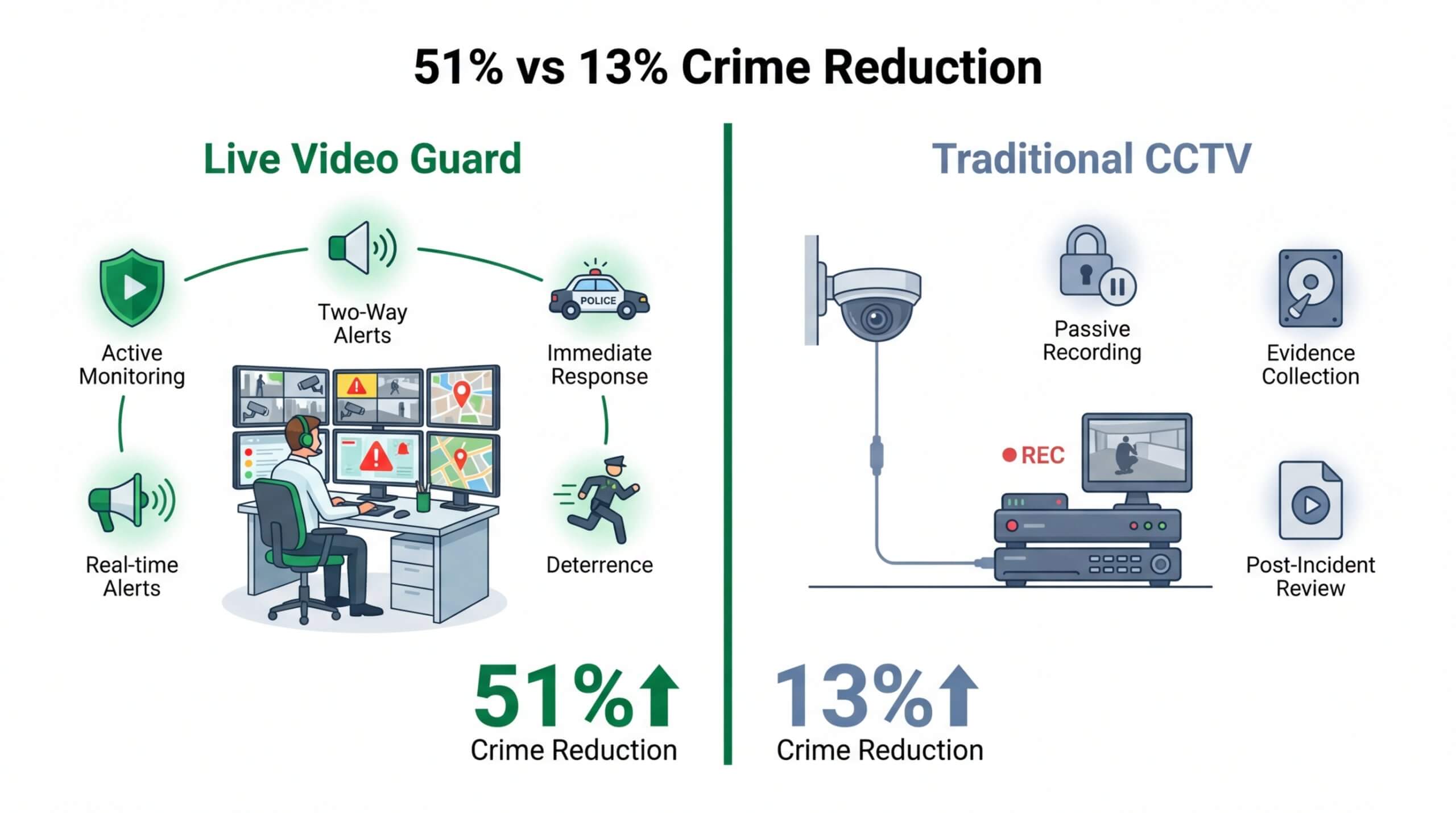
The performance gap between the two approaches is significant. Passive CCTV produces a modest 13% crime reduction overall, while actively monitored systems push that figure as high as 51% depending on location and deployment. Properties facing high-value theft risk (construction sites, auto dealerships, commercial facilities, and unoccupied residences) consistently benefit most from the shift to live monitoring.
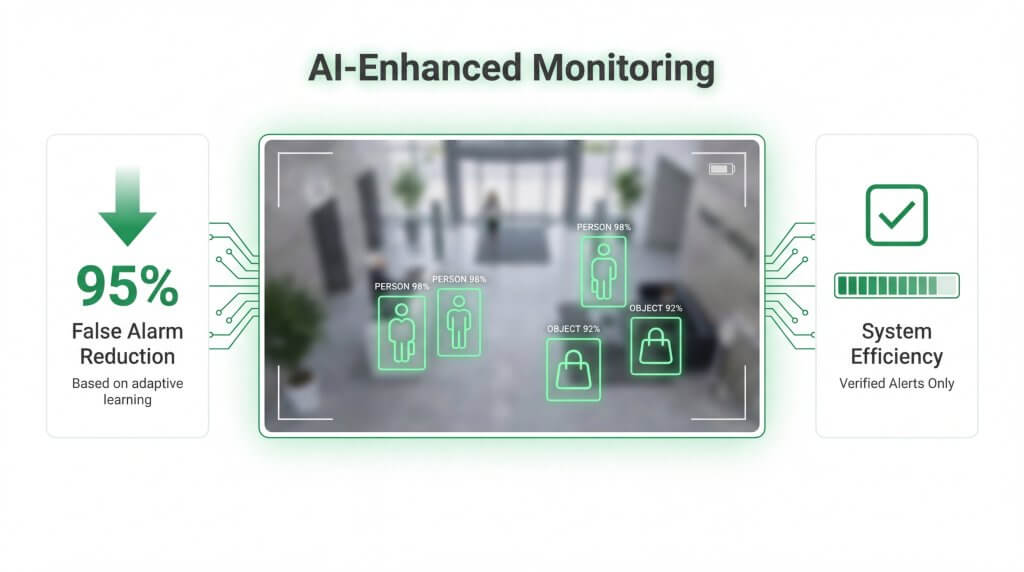
AI further sharpens this advantage by filtering up to 95% of false alarms, ensuring operators focus exclusively on genuine threats rather than irrelevant motion triggers.
What Is a Live Video Guard?
A live video guard is a trained security operator who monitors your property remotely through real-time video feeds, intervening the moment a threat appears. The sections below explain how real-time monitoring works, what technology drives it, and what happens when a threat is detected.
How Does a Live Video Guard Monitor Your Property in Real Time?
A live video guard monitors your property in real time by watching live camera feeds from a remote monitoring center and responding immediately when suspicious activity appears. Unlike traditional CCTV, which transmits video to a local recorder primarily for post-incident investigation, live video monitoring combines continuous human observation with AI-powered analytics to detect threats as they develop.
This distinction matters because traditional CCTV systems often fail to prevent crime; without real-time intervention capabilities, they serve only as passive witnesses. According to Volt AI, live video monitoring shifts security from reactive to proactive by pairing always-on camera feeds with operators who can trigger two-way audio warnings, activate sirens, or dispatch law enforcement within seconds.
Standard on-site guards face a well-documented limitation: after extended periods watching video displays, fatigue sets in and critical events get missed. Remote monitoring stations solve this by rotating operators across shifts and layering AI alerts that flag anomalies before human attention lapses. For property owners weighing whether remote coverage is sufficient or physical presence is necessary, the answer often depends on site layout and risk profile. Spread-out properties with multiple entry points frequently benefit more from continuous camera coverage than a single guard patrolling on foot.
What Technology Powers a Live Video Guard System?
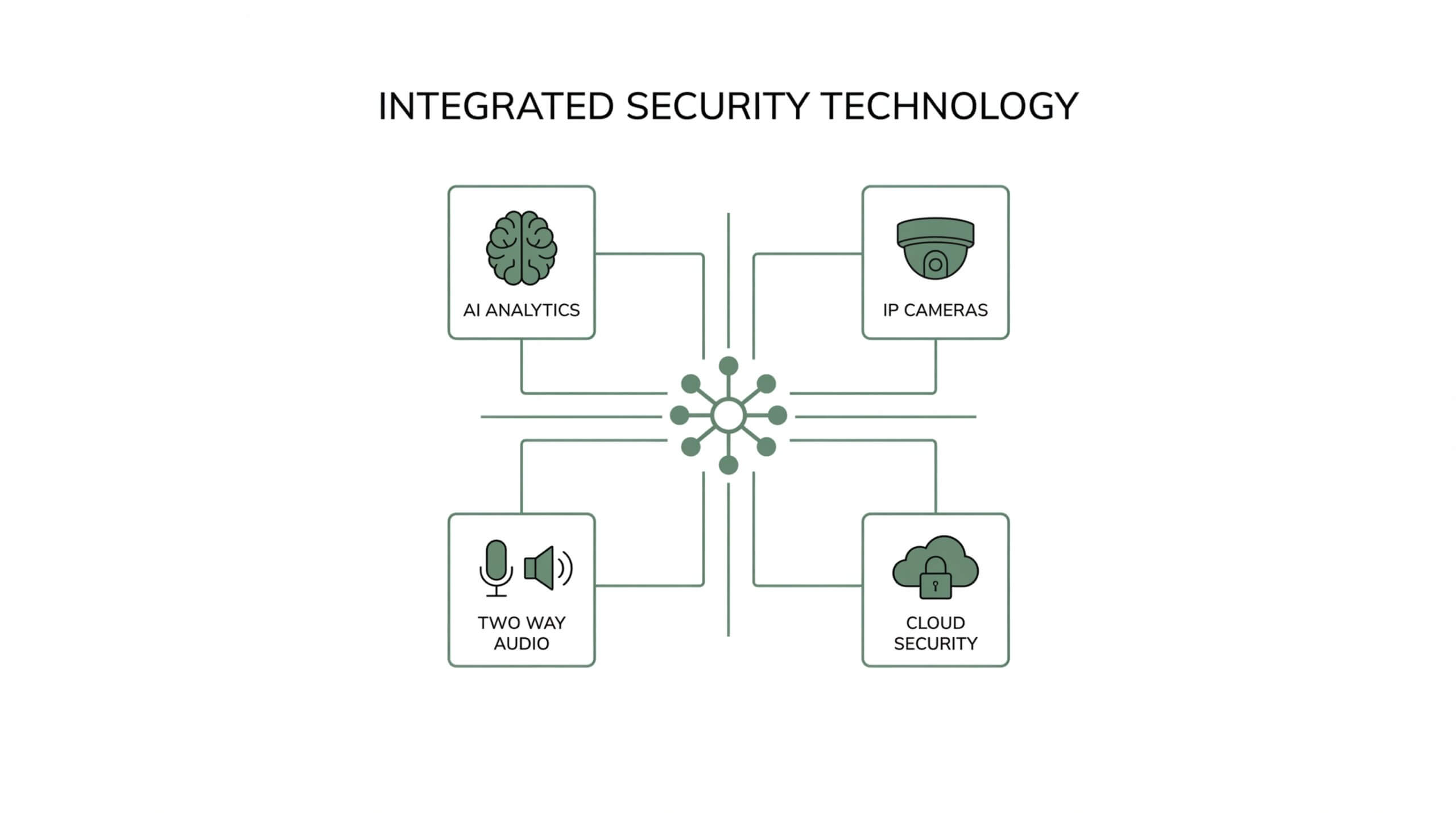
A live video guard system is powered by several integrated technologies working together:
- AI-driven video analytics use machine learning algorithms to distinguish genuine threats from routine movement, filtering out false alarms before they reach an operator.
- High-resolution IP cameras (4K/8MP) capture detailed footage across wide areas, even in low-light conditions, ensuring identifiable imagery day and night.
- PoE (Power over Ethernet) hubs with dedicated GPUs process video data on-site, enabling faster anomaly detection without relying solely on cloud bandwidth.
- Two-way audio speakers and sirens allow remote operators to issue verbal warnings or trigger deterrent sounds the instant suspicious behavior is confirmed.
- Encrypted cloud connectivity streams live feeds to monitoring centers while maintaining secure data transmission compliant with privacy regulations like GDPR and CCPA.
These components create a closed-loop system where detection, verification, and response happen within a single workflow, rather than across disconnected tools.
What Happens When a Live Video Guard Detects a Threat?
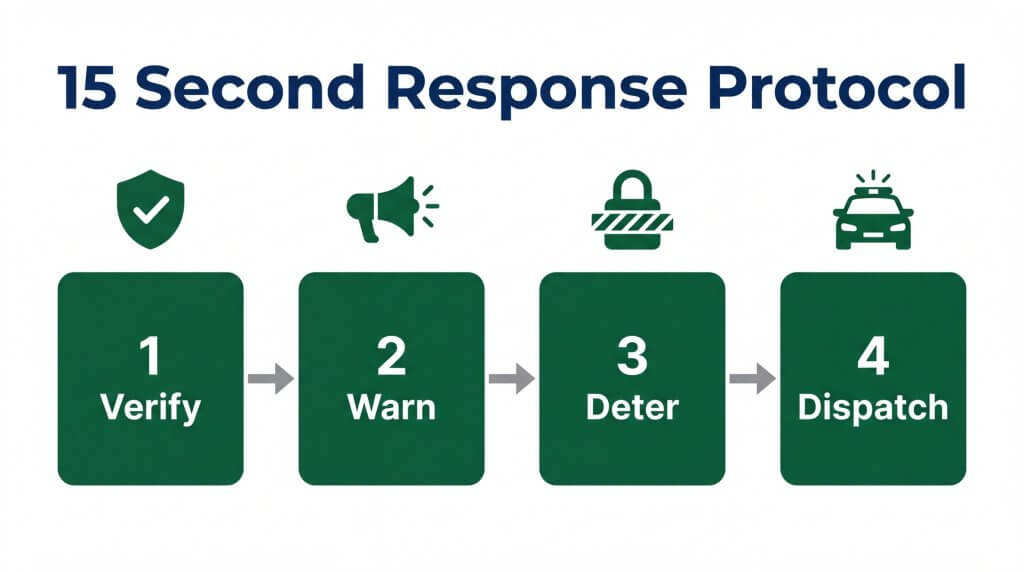
A live video guard follows a structured escalation protocol the moment a threat is detected. According to TechPro Security, when video analytics trigger automatic alerts, remote guards typically respond within 5 to 15 seconds. The response sequence includes:
- Verification: The operator reviews the flagged feed to confirm whether the alert represents a genuine threat or a false trigger.
- Verbal intervention: If the threat is real, the guard issues a live audio warning through on-site speakers, addressing the intruder directly.
- Deterrent activation: Sirens and strobe lights activate simultaneously to disrupt the intrusion attempt.
- Law enforcement dispatch: When the intruder does not leave, the operator contacts local police with verified video evidence, which often elevates the call priority.
This layered approach means most incidents are resolved before physical damage occurs. Understanding how live video guards operate makes it easier to see where traditional CCTV falls short.
How Does Traditional CCTV Surveillance Work?
Traditional CCTV surveillance works by transmitting video feeds from cameras to a local recorder or monitor, creating a closed circuit that captures footage for later review. This system primarily serves as a passive record-keeping tool rather than an active crime prevention measure.
A traditional CCTV setup includes cameras, coaxial or network cabling, a digital video recorder (DVR) or network video recorder (NVR), and a display monitor. Cameras capture footage continuously or on a motion-triggered schedule, storing it locally for a set retention period. When an incident occurs, security personnel or law enforcement review the recorded footage after the fact to identify suspects, reconstruct timelines, or gather evidence for prosecution.
The fundamental limitation of this approach is its reactive nature. Traditional CCTV systems often fail to prevent crime because they lack real-time intervention capabilities, serving only as passive witnesses to events that have already unfolded. According to Backstreet Surveillance, the first commercially available CCTV systems were manufactured and sold in the United States starting in 1949, and while camera resolution and storage capacity have improved dramatically since then, the core operational model remains largely unchanged.
Most CCTV footage goes unwatched because human operators cannot effectively monitor multiple screens for extended periods without fatigue. Even when a facility employs a guard to watch live feeds, attention degrades significantly after the first 20 minutes of continuous screen viewing. The result is a system that records plenty of evidence but rarely stops a crime in progress.
This passive approach creates a critical gap between capturing footage and taking action, which is precisely where live video guard technology steps in.
What Are the Key Differences Between Live Video Guards and Regular CCTV?
The key differences between live video guards and regular CCTV come down to response time, crime prevention capability, human monitoring, and evidence quality. Each factor shapes how effectively a system protects property.
How Does Response Time Compare Between Live Video Guards and CCTV?
Response time between live video guards and CCTV differs dramatically. Live video guards monitor feeds in real time, so when video analytics flag suspicious activity, a trained operator can assess and respond within seconds. Regular CCTV, by contrast, typically records footage for later review. No one is watching as events unfold, which means the “response” only begins after someone discovers the incident, sometimes hours or days later.
This gap matters most during active threats, where seconds determine whether a crime is prevented or simply documented. For CCTV footage to serve any post-incident purpose, it must be high quality, correctly time-stamped, and maintain a clear chain of custody, according to Resolute Partners. Without real-time human oversight, even well-maintained CCTV becomes a reactive tool rather than a preventive one.
How Does Crime Prevention Differ Between Live Video Guards and CCTV?
Crime prevention differs significantly between live video guards and CCTV because active monitoring produces measurably stronger deterrence than passive recording. According to a 40-year meta-analysis published in Criminology & Public Policy (Piza et al., 2019), CCTV is associated with a modest 13% decrease in crime overall. However, CCTV schemes incorporating active monitoring generated larger effect sizes than passive systems.
Location also influences effectiveness. The largest effects were observed in car parks, where CCTV produced a 37% crime reduction. Across all settings, monitored CCTV can reduce crime by 13% to 51% depending on the type of system deployed. Live video guards push results toward the higher end of that range because they combine real-time observation with immediate intervention capabilities, such as two-way audio warnings and direct police dispatch.
How Does Human Monitoring Differ From Passive Video Recording?
Human monitoring differs from passive video recording in purpose and timing. Passive monitoring involves reviewing recorded footage after events have occurred, serving primarily investigative, prosecution, and training purposes. A trained operator, on the other hand, watches live feeds and intervenes as situations develop.
This distinction transforms security from documentation into prevention. AI video analytics further strengthen human monitoring; a 2025 study in the Journal of Engineering and Computer Sciences found that false positive rates in AI-assisted public safety systems declined from 16.8% to 2.4% through machine learning improvements. That precision means human operators spend less time chasing false alerts and more time responding to genuine threats. For most properties, combining trained operators with AI filtering delivers the most reliable protection available today.
How Do Live Video Guards and CCTV Compare on Evidence Quality?
Live video guards and CCTV compare favorably on evidence quality, though live systems hold a practical advantage. Under Rule 901 of the Federal Rules of Evidence, surveillance video is generally admissible in court if the moving party meets the burden of authenticating the footage. Both systems can satisfy this standard when properly maintained.
Where live video guards excel is in documentation consistency. Because trained operators are actively watching, they can ensure cameras capture critical moments clearly, note timestamps in real time, and maintain a verifiable chain of custody from incident through law enforcement handoff. Passive CCTV often suffers from gaps, poor angles, or overwritten footage that weakens its evidentiary value.
Understanding these differences helps clarify which security scenarios call for live monitoring versus standard surveillance.
What Are the Limitations of Regular CCTV Systems?
The limitations of regular CCTV systems center on passive recording, operator fatigue, image quality issues, and the inability to intervene during an active incident. These weaknesses explain why many property owners find traditional surveillance insufficient as a standalone security measure.
Regular CCTV technology has been commercially available since 1949, according to Backstreet Surveillance, yet the fundamental design philosophy has changed little. These systems capture footage for review after an event has already occurred. Without real-time human oversight or AI-driven alerts, cameras function as silent witnesses rather than active deterrents.
- No real-time intervention: Traditional cameras record incidents but cannot stop them in progress, leaving property owners to rely on footage for after-the-fact investigation.
- Operator fatigue: Human monitors lose effectiveness when watching multiple screens over extended periods, causing critical events to go unnoticed.
- Image quality gaps: Grainy or blurry footage, often caused by poor resolution or camera focus limitations, can make suspect identification unreliable.
- Bandwidth constraints: Network limitations may interrupt surveillance feeds, creating blind spots during the moments that matter most.
- Reactive by design: Because standard CCTV lacks two-way audio or automated alerting, it cannot deter trespassers or trigger emergency responses in real time.
For properties requiring active crime prevention rather than passive documentation, these shortcomings represent a significant security gap. Understanding where traditional CCTV falls short makes it easier to evaluate when a live video guard solution becomes the stronger choice.
When Should You Choose a Live Video Guard Over Standard CCTV?
You should choose a live video guard over standard CCTV when your property faces high-value theft risk, after-hours vulnerability, or the need for real-time intervention. The following sections cover when construction sites, auto dealerships, commercial properties, and residential properties benefit most.
When Does a Construction Site Need a Live Video Guard?
A construction site needs a live video guard when high-value equipment, materials, or tools are left unattended during off-hours. Open perimeters and rotating crews make these sites especially vulnerable to organized theft.
According to the National Equipment Register, the average theft incident at a construction site costs approximately $30,000, a substantial financial hit for small- to medium-sized contractors. Standard CCTV records the loss but rarely prevents it, since no one is watching in real time. A live video guard can issue audio warnings the moment someone breaches the perimeter, stopping theft before materials leave the site.
Construction projects with phased timelines face shifting blind spots as the site layout changes weekly. For these dynamic environments, live monitoring adapts far more effectively than static camera placement alone.
When Does an Auto Dealership Need a Live Video Guard?
An auto dealership needs a live video guard when its lot holds dozens of vehicles exposed overnight across a wide, open area. Catalytic converter theft, vandalism, and joyriding all spike after business hours when no staff is present.
Multiple cooperative video sensors provide continuous coverage and autonomous surveillance across sprawling lots, as noted in a ResearchGate study on video surveillance systems. This multi-camera approach, paired with a live operator, means every row and corner stays monitored simultaneously. Standard CCTV captures footage, but without a human watching in real time, the evidence only helps after the damage is done.
Dealerships storing high-value inventory outdoors overnight represent one of the clearest cases where passive recording simply cannot match the deterrence value of an alert, responsive guard.
When Does a Commercial Property Need a Live Video Guard?
A commercial property needs a live video guard when it contains valuable inventory, sensitive areas, or large perimeters that staff cannot physically patrol around the clock. Warehouses, office complexes, and retail centers all share this vulnerability.
Properties with multiple entry points, loading docks, and parking structures create too many zones for a single on-site guard to cover effectively. A live video guard monitors all access points simultaneously from a centralized station, issuing audio challenges to anyone who shouldn’t be there. This is particularly critical for businesses operating limited weekend or holiday hours, when break-in risk increases and response windows narrow.
For most commercial operators, the combination of broad coverage and immediate human response makes live monitoring the more practical choice over passive CCTV.
When Does a Residential Property Need a Live Video Guard?
A residential property needs a live video guard when the homeowner wants real-time exterior monitoring that goes beyond motion-triggered alerts. Homes with large yards, detached garages, gated driveways, or vacation properties left unoccupied for extended periods benefit the most.
Standard CCTV sends a notification after motion is detected, but no one intervenes. A live video guard watches the feed, verifies the threat, and can activate two-way audio or contact law enforcement before an intruder reaches a door or window. This proactive layer is especially valuable for families with predictable travel schedules or homes in areas with slower police response times.
When the goal shifts from documenting incidents to preventing them entirely, live video monitoring becomes the stronger choice for residential security.
How Does AI Enhance Live Video Guard Services?
AI enhances live video guard services by automating threat detection, filtering false alarms, and enabling faster human response. These improvements transform surveillance from a passive recording tool into an intelligent, proactive security layer.
AI-powered video analytics dramatically reduce false alarms that waste operator time and delay real responses. According to a 2025 study published in the Journal of Engineering and Computer Sciences, false positive rates in AI video analytics for public safety declined from 16.8% to 2.4% through machine learning improvements. This precision allows human operators to focus exclusively on genuine threats rather than chasing irrelevant motion triggers. When analytics flag a verified event, remote guards typically respond within 5 to 15 seconds, a speed no traditional system can match consistently. AI also classifies objects in real time, distinguishing between animals, vehicles, and people to prioritize alerts that matter. For property owners weighing security investments, AI integration represents the clearest operational advantage live video guards hold over conventional CCTV. With AI handling detection, the next consideration is choosing a provider that leverages this technology effectively.
What Should You Look for in a Live Video Guard Provider?
You should look for a live video guard provider that combines trained human operators, advanced AI analytics, verified response protocols, and transparent service agreements. The key evaluation criteria include monitoring quality, response speed, technology infrastructure, and compliance standards.
- 24/7 US-based monitoring operators who maintain real-time watch over your cameras without fatigue-related coverage gaps.
- AI-powered video analytics that filter false alarms and flag genuine threats before human review, reducing unnecessary dispatches.
- Response time under 15 seconds, with documented escalation procedures including two-way audio intervention and direct police dispatch.
- High-resolution camera requirements (4K/8MP minimum) ensuring footage remains admissible and useful for identification.
- Privacy controls and compliance with applicable regulations, giving property owners authority over their surveillance data.
- Verified crime-in-progress reporting, which increases law enforcement priority compared to standard unverified alarm calls.
- Customizable coverage plans tailored to your property type, whether commercial, residential, construction, or auto dealership.
Not every provider delivers equal value across these criteria. The best live video guard services prove their operators are proficient, maintain transparent escalation logs, and integrate AI filtering that meaningfully reduces false alerts. Providers lacking these capabilities often deliver little more than rebranded passive CCTV with a higher price tag, which defeats the purpose of upgrading to active monitoring.
With these evaluation criteria established, Pioneer Security’s approach demonstrates how AI-powered live monitoring applies them in practice.
How Can Pioneer Security’s AI-Powered Live Video Monitoring Protect Your Property?
Pioneer Security’s AI-powered live video monitoring protects your property by combining real-time human surveillance with intelligent video analytics that detect and deter threats before damage occurs. Below, explore how US-based video guards prevent crime and the key takeaways from live video guard technology.
Can Pioneer Security’s US-Based Video Guards Help Prevent Crime Before It Happens?
Yes, Pioneer Security’s US-based video guards can help prevent crime before it happens. Pioneer Security stations trained operators in US-based monitoring centers who watch live camera feeds around the clock. When AI-powered analytics flag suspicious activity, these guards respond immediately through two-way audio, issuing verbal warnings to trespassers before a break-in occurs. This proactive intervention model replaces the reactive approach of traditional CCTV, where footage only serves as evidence after a crime. According to Traces AI, AI-powered video analytics can remove up to 95% of false alarms by accurately detecting and classifying objects of interest. Fewer false alerts mean guards focus on genuine threats, and verified incidents receive faster police dispatch.
What Are the Key Takeaways About Live Video Guards and How They Differ From Regular CCTV?
The key takeaways about live video guards and how they differ from regular CCTV center on intervention, intelligence, and outcome:
- Live video guards provide real-time human monitoring; regular CCTV records passively for post-incident review.
- AI-enhanced systems dramatically reduce false alarms, keeping response focused on actual threats.
- Two-way audio enables direct verbal deterrence, something standalone cameras cannot offer.
- Active monitoring generates larger crime reduction effects than passive surveillance alone.
- Verified alarm dispatches improve police response priority compared to unverified CCTV alerts.
For property owners weighing passive recording against proactive protection, the difference is clear. Pioneer Security, a family-owned provider since 1978, combines these advantages into a single AI-powered platform backed by US-based professionals ready to stop crime before it starts.