Video guard monitoring reduces parking lot security incidents by combining AI-driven threat detection with trained remote operators who intervene in real time, stopping crimes before they are completed. Unlike passive recorded surveillance, live monitoring closes the gap between detection and response.
This guide covers parking lot crime risks, how live video monitoring technology works, why proactive surveillance outperforms traditional security methods, which property types benefit most, camera placement strategy, and the liability and ROI implications for business owners.
Parking lots rank among the most crime-prone locations in the country, with vehicle theft, break-ins, carjacking, and assault concentrating in areas defined by open access, poor lighting, and minimal foot traffic. Unmonitored lots signal low detection risk to offenders, and off-peak hours create vulnerability windows that traditional staffing cannot cover.
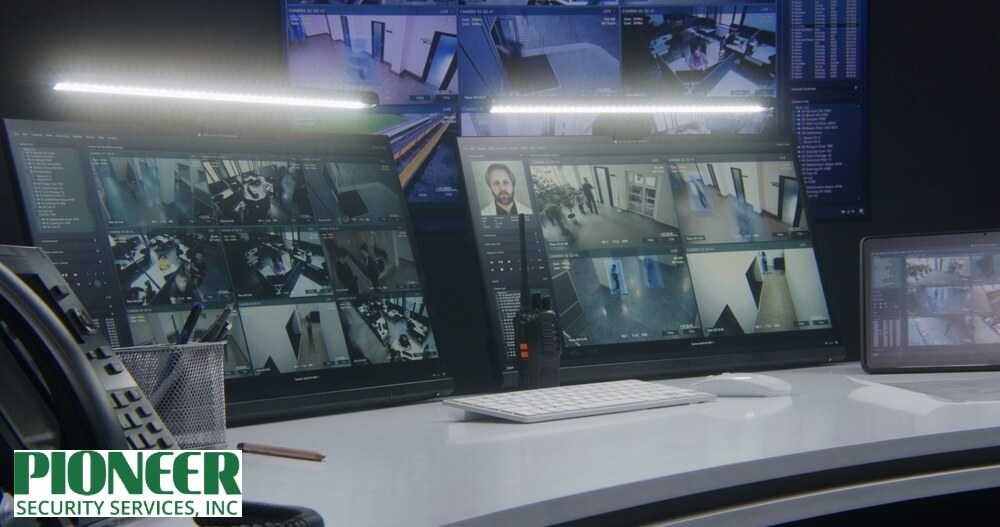
Live video monitoring systems layer high-resolution IP cameras, AI-enabled analytics, and centralized command centers staffed by trained operators. When the system flags suspicious behavior, remote guards verify the threat visually and respond within seconds through two-way audio warnings, siren activation, or verified police dispatch.
This proactive cycle outperforms both passive cameras and traditional guard patrols. AI-powered detection filters false alarms so operators focus on genuine threats, while live audio warnings introduce an immediate human presence that disrupts criminal intent at the point of approach.
Retail centers, corporate complexes, hospitals, residential communities, and hotels each face distinct parking lot risks that real-time monitoring directly addresses. Strategic camera placement at entry points, perimeter lines, and blind corners maximizes coverage across any lot size.
Documented monitoring also reduces premises liability exposure, strengthens legal defenses against negligent security claims, and delivers measurable ROI through fewer incidents, lower insurance premiums, and stronger customer retention.
What Makes Parking Lots High-Risk Areas for Crime?
Parking lots are high-risk areas for crime because they combine open access, low foot traffic, and limited surveillance into environments that favor opportunistic offenders. According to the U.S. Department of Justice, parking lots and garages rank as the third most crime-prone areas in the country. The sections below examine the most common offenses, why unmonitored lots attract criminals, and when vulnerabilities peak.
What Types of Crimes Happen Most Often in Parking Lots?
The types of crimes that happen most often in parking lots include vehicle theft, theft from vehicles, carjacking, vandalism, and assault. Vehicle-related offenses dominate because cars left unattended in open lots present low-risk, high-reward targets. An Urban Institute study found that almost one-quarter (23.7 percent) of car thefts and nearly 12 percent of all thefts from vehicles in the United States occur in parking lots or garages. Property crimes like smash-and-grabs tend to cluster in areas with poor sightlines, while violent crimes such as robbery and assault often occur near stairwells or secluded corners where escape routes are close. For property managers, recognizing this concentration of crime types is the first step toward choosing the right deterrence strategy.
Why Are Unmonitored Parking Lots Attractive to Criminals?
Unmonitored parking lots are attractive to criminals because the absence of active surveillance creates a perceived low risk of detection. Without live monitoring, offenders can operate with little fear of real-time intervention. Several factors compound this vulnerability:
- Large, open layouts provide multiple entry and exit points for quick escape.
- Sparse lighting after business hours reduces natural visibility.
- Infrequent foot traffic means fewer potential witnesses.
- Static cameras without live operators offer only post-incident evidence, not prevention.
Criminals assess risk before acting. A lot with no visible monitoring signals that no one is watching, which lowers the psychological barrier to committing an offense. This is precisely why proactive, real-time video monitoring changes the equation so dramatically compared to passive recorded surveillance alone.
When Are Parking Lots Most Vulnerable to Security Threats?
Parking lots are most vulnerable to security threats during overnight hours, early morning periods, and transitional times when occupancy drops sharply. Reduced lighting, minimal staff presence, and fewer vehicles create conditions that embolden offenders. Weekend evenings and holidays also present heightened risk because routine foot traffic decreases while lots remain accessible. As the Security Industry Association reported in 2023, making parking lots smarter and more secure requires addressing these off-peak windows where traditional staffing falls short. The liability implications are significant; negligent security falls under premises liability, which can involve lawsuits when a person is injured by a third party’s criminal act on someone else’s property. Identifying peak vulnerability windows helps property owners deploy monitoring resources where they matter most.
Understanding when and why parking lots face elevated risk sets the foundation for evaluating how video guard monitoring directly counters these threats.
How Does Video Guard Monitoring Work for Parking Lot Security?
Video guard monitoring works by combining networked camera hardware, AI-driven analytics, and trained remote operators to detect and address threats as they unfold. The subsections below cover the core technology stack, real-time threat response, and how live monitoring differs from passive recorded surveillance.
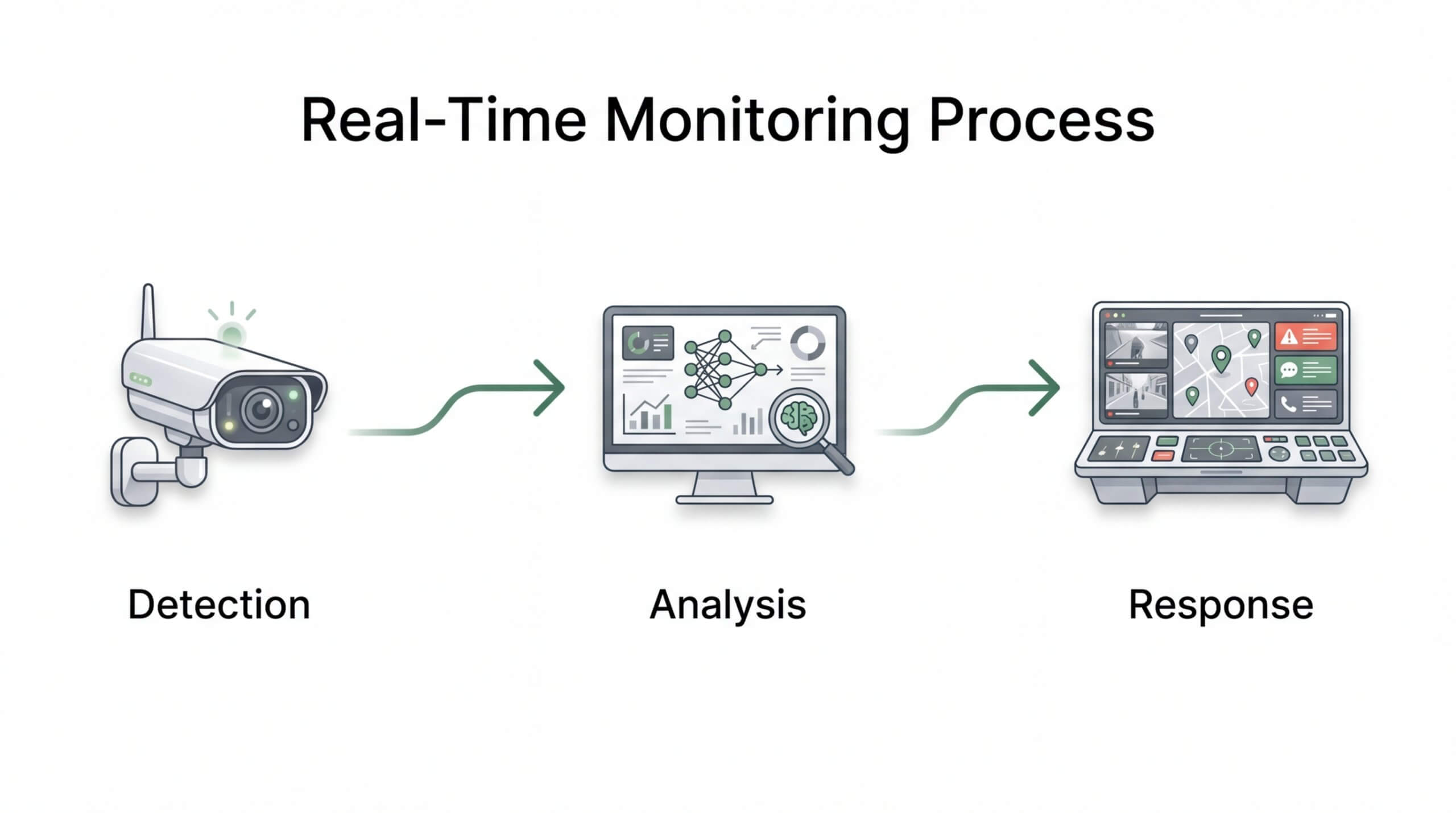
What Technology Powers Live Video Monitoring Systems?
Live video monitoring systems are powered by a layered technology stack that includes high-resolution IP cameras, AI-enabled video analytics, integrated access control, and centralized command centers staffed by trained operators. High-definition 4K and 8MP cameras capture detailed footage across parking lots, while Power-over-Ethernet (PoE) hubs with dedicated GPUs process visual data on-site for faster analysis.
According to a 2023 ASIS International access control research report, 54 percent of organizations have already merged their access control with video monitoring. This convergence allows a single platform to manage camera feeds, gate access, and alarm triggers simultaneously, eliminating the blind spots that arise when these systems operate in isolation. For parking lot security specifically, integrated platforms mean a camera detecting unusual movement can instantly lock down entry barriers and alert a remote guard without manual intervention.
How Do Remote Guards Detect and Respond to Threats in Real Time?
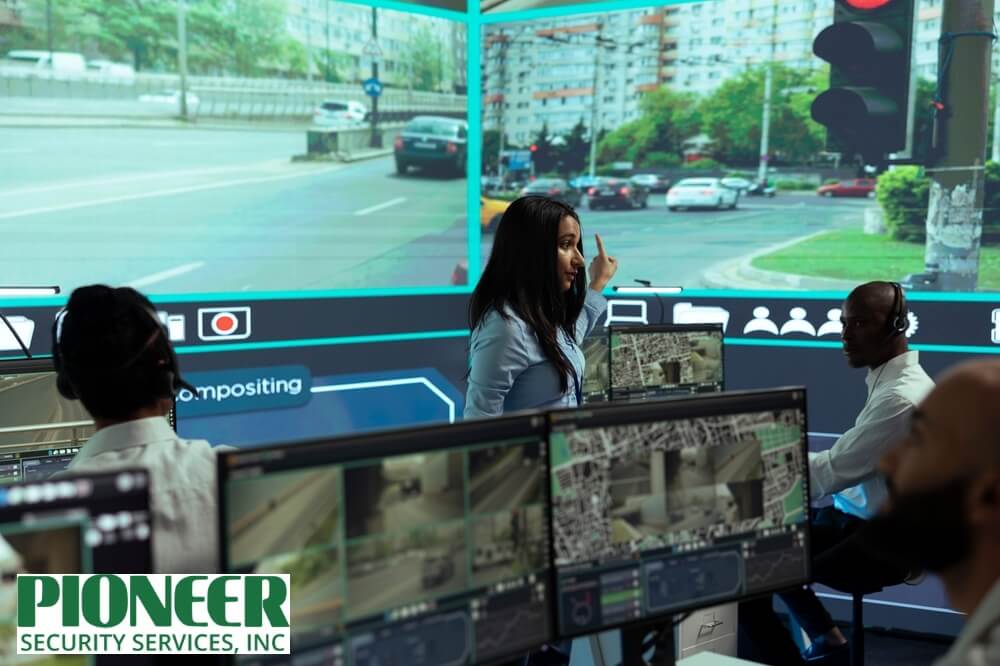
Remote guards detect and respond to threats in real time by monitoring live camera feeds from centralized U.S.-based command centers, supported by AI-powered alert systems that flag suspicious activity the moment it occurs. Rather than scanning dozens of static screens, operators receive prioritized smart alerts generated through computer vision and deep learning algorithms. As documented in the U.S. Department of Homeland Security’s 2025 Video Security Systems Handbook, AI-powered video analytics convert passive video into useful smart alerts by analyzing footage in real time.
When the system flags an anomaly, such as someone approaching vehicles after hours or an unauthorized person entering a restricted zone, the remote guard verifies the threat visually and responds within seconds. Response options include:
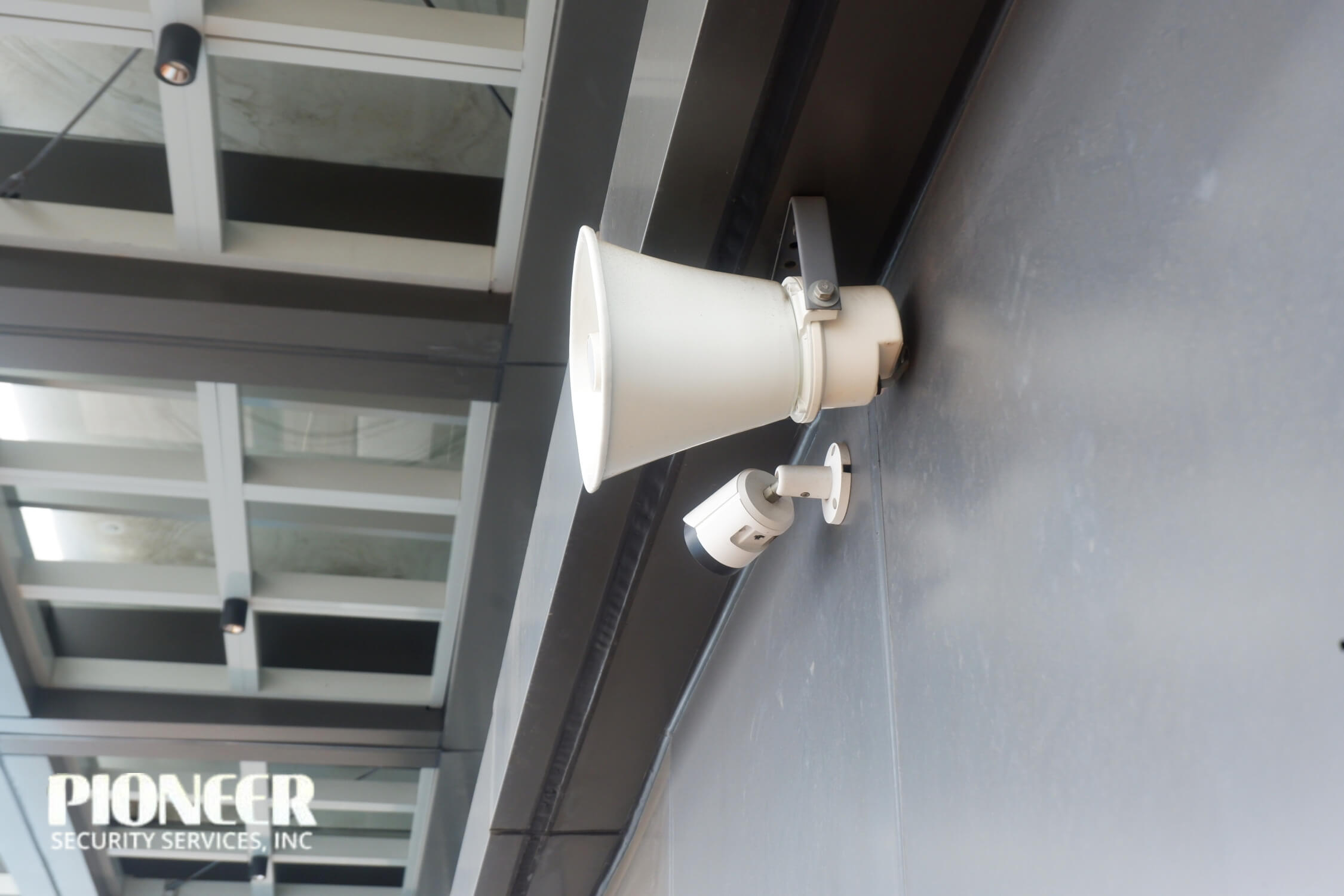
- Issuing live two-way audio warnings to deter the individual directly.
- Activating on-site sirens and strobe lights to draw attention.
- Dispatching local law enforcement with verified crime-in-progress status for faster police response.
This proactive cycle of detection, verification, and intervention is what separates live monitoring from systems that simply record events for later review.
What Is the Difference Between Recorded Surveillance and Live Monitoring?
The difference between recorded surveillance and live monitoring is that recorded surveillance captures footage for after-the-fact review, while live monitoring enables real-time human intervention before a crime is completed. Recorded systems store video on local drives or cloud servers, providing evidence after an incident has already occurred. They are reactive by design; no one watches the feed as events unfold.
Live monitoring, by contrast, places trained remote guards in an active observation role around the clock. When suspicious behavior appears on camera, operators can immediately verify the threat, issue audio deterrents, and contact authorities. This shift from passive documentation to proactive response is what makes live systems significantly more effective at reducing parking lot incidents. Recorded footage helps with investigations; live monitoring helps prevent the incident from happening in the first place.
With a clear understanding of how this technology operates, the next step is examining why proactive monitoring outperforms traditional security approaches.
Why Does Proactive Video Monitoring Reduce Incidents More Than Traditional Security?
Proactive video monitoring reduces incidents more than traditional security because it enables real-time intervention before a crime is completed. The subsections below cover how live intervention prevents crimes, why audio warnings deter trespassers, and how AI detection improves response accuracy.
How Does Real-Time Intervention Prevent Crimes Before They Occur?
Real-time intervention prevents crimes before they occur by allowing trained remote guards to detect suspicious activity and respond within seconds, not after the fact. Traditional security cameras record footage for post-incident review, which means the crime has already happened before anyone acts. Live monitoring closes that gap.
According to the U.S. Department of Justice COPS Office, cars parked in lots were six times more likely to be stolen than cars parked on the street. When a remote guard spots someone testing door handles or lingering near vehicles, they can trigger lights, issue a verbal warning, or dispatch police immediately.
This shift from reactive documentation to proactive deterrence is what separates monitored systems from passive surveillance. For most parking facilities, the ability to stop a theft or assault mid-attempt delivers far greater value than any amount of recorded evidence after the fact.
Why Are Live Audio Warnings Effective at Deterring Trespassers?
Live audio warnings are effective at deterring trespassers because they introduce an immediate, unexpected human presence that disrupts criminal intent. Most offenders rely on anonymity and the assumption that no one is watching. A direct voice command from a two-way speaker system shatters that assumption instantly.
When a remote guard addresses a trespasser by describing their appearance, location, or actions, the psychological impact is significant. The individual realizes they have been identified and are being observed in real time. In most cases, this alone causes the person to leave the property before any physical confrontation or property damage occurs.
Passive systems like alarm sirens or flashing lights lack this specificity. A siren alerts everyone indiscriminately, while a targeted audio warning communicates direct, personal accountability to the individual causing the threat.
How Does AI-Powered Detection Improve Response Accuracy?
AI-powered detection improves response accuracy by filtering out false triggers and prioritizing genuine threats for human review. Traditional motion sensors generate frequent false alarms from animals, weather, or shifting shadows, which desensitize both security teams and law enforcement over time.
Modern AI video analytics use integrated computer vision and deep learning to analyze video in real time, distinguishing between a person scaling a fence and a plastic bag blowing across the lot. This precision means remote guards receive smart alerts only when behavior patterns match known threat profiles, such as loitering, perimeter breaches, or vehicle break-in attempts.
The result is faster, more accurate responses with fewer wasted resources. For property managers weighing security investments, AI-assisted monitoring consistently outperforms traditional alarm-based systems in both detection reliability and incident prevention. With response accuracy established, the next consideration is which parking lot types benefit most from this technology.
What Types of Parking Lots Benefit Most From Video Guard Monitoring?
The types of parking lots that benefit most from video guard monitoring include retail centers, corporate complexes, hospitals, residential communities, and hotels. Each faces distinct security challenges that real-time surveillance directly addresses.
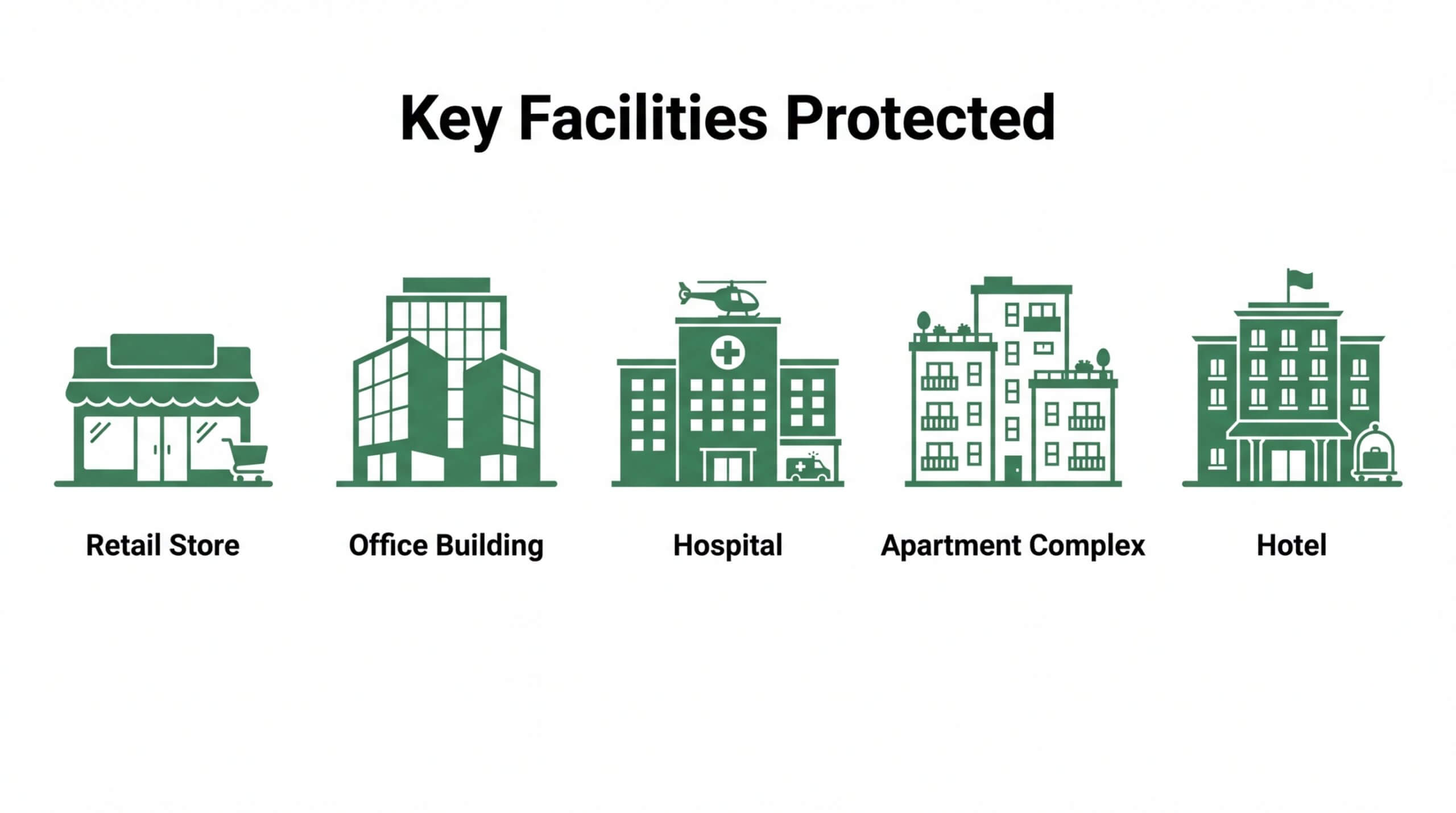
Retail and Shopping Center Parking Lots
Retail and shopping center parking lots rank among the highest-risk environments for vehicle-related crime. According to a 2024 GlobeNewswire report, one-third of U.S. women avoid in-person shopping due to parking lot safety concerns. That statistic alone signals a direct revenue impact for retailers who neglect visible security measures.
These lots present unique challenges because of their sheer scale; shopping centers typically require one parking spot per 100 square feet of floor area, creating massive surveillance zones. Video guard monitoring covers these expansive areas with fewer resources than traditional patrols, while live audio warnings deter theft and confrontations before they escalate. For retailers, proactive monitoring protects both customers and bottom-line foot traffic.
Corporate and Office Complex Parking Structures
Corporate and office complex parking structures face security risks concentrated around predictable schedules. Employees arrive and depart at consistent times, leaving vehicles unattended for hours in multi-level garages with limited sightlines.
Video guard monitoring addresses these blind spots through strategically placed cameras paired with real-time human observation. Remote guards can identify unauthorized individuals lingering near vehicles during off-peak hours and intervene with live audio deterrents. This level of protection also reduces employer liability, since businesses have a duty of care to provide reasonably safe premises for employees and visitors.
Hospital and Healthcare Facility Parking Areas
Hospital and healthcare facility parking areas require security around the clock because these locations never close. Staff working overnight shifts, patients arriving during emergencies, and visitors under emotional stress all converge in poorly lit garages at vulnerable hours.
Video guard monitoring provides continuous oversight without the cost of staffing multiple on-site guards across every parking level. Remote operators can spot suspicious behavior, coordinate with hospital security teams in real time, and ensure that emergency vehicle lanes remain clear. Given the heightened duty of care healthcare facilities owe to patients, proactive monitoring is a practical safeguard.
Apartment and Residential Community Parking Garages
Apartment and residential community parking garages serve as persistent targets because they offer repeat access to the same vehicles night after night. Residents expect safe parking as part of their living arrangement, making security a factor in tenant retention and satisfaction.
Video guard monitoring deters break-ins and vandalism by maintaining a visible, active surveillance presence. Live operators can challenge unauthorized individuals entering gated structures and alert property management immediately. For property owners, this proactive approach reduces incident reports, strengthens lease renewal rates, and demonstrates the reasonable security measures that premises liability standards increasingly demand.
Hotel and Hospitality Parking Lots
Hotel and hospitality parking lots present a distinct challenge: a constantly rotating population of unfamiliar vehicles and guests. Unlike corporate or residential lots, there is no baseline of “normal” activity for staff to recognize.
Video guard monitoring compensates for this unpredictability. AI-assisted analytics flag unusual behavior patterns while remote guards verify threats in real time, distinguishing late-arriving guests from potential criminals. Hotels also face reputational risk when parking lot incidents make headlines, so visible security infrastructure reassures guests and protects brand perception. With over 21% of all vehicle theft offenses occurring in parking lots according to 2022 FBI NIBRS data, hospitality properties cannot afford passive surveillance alone.
How Does Video Monitoring Compare to On-Site Security Guards for Parking Lots?
Video monitoring compares to on-site security guards by offering broader simultaneous coverage, faster AI-assisted detection, and lower long-term costs, while guards provide physical presence and hands-on intervention. The key differences span coverage, cost, response capability, and scalability.
| Factor | Live Video Monitoring | On-Site Security Guards |
| Coverage Area | Monitors entire lot simultaneously via multiple cameras | Limited to one patrol zone at a time |
| Hours of Operation | 24/7 without breaks, shift changes, or call-outs | Subject to fatigue, sick days, and shift gaps |
| Response Method | Real-time audio warnings, light activation, and police dispatch | Physical presence and direct confrontation |
| Scalability | Adds cameras without proportional cost increase | Each additional guard doubles labor expense |
| Detection Speed | AI analytics flag threats in seconds | Depends on guard’s line of sight and alertness |
| Evidence Collection | Continuous 4K recording with timestamped footage | Relies on written incident reports |
| Cost Structure | Fixed monthly monitoring fee | Hourly wages, benefits, training, and turnover costs |
A single guard cannot observe every corner of a large parking lot at once, especially during overnight hours when visibility drops and fatigue sets in. Video monitoring systems eliminate these blind spots by providing persistent, multi-angle surveillance that never loses concentration.
That said, guards still serve a role where physical intervention is legally required or where human judgment in complex, ambiguous situations adds value. The most effective parking lot security programs often layer both: remote video monitoring handles continuous surveillance and rapid detection, while guards respond to verified incidents that demand a physical presence. For most property managers, prioritizing video monitoring as the primary security layer and supplementing with guards only where necessary delivers the strongest protection per dollar spent.
With this comparison in mind, strategic camera placement determines how effectively video monitoring covers every vulnerable zone.
What Camera Placement Strategies Maximize Parking Lot Coverage?
Camera placement strategies that maximize parking lot coverage prioritize entry and exit points, eliminate blind spots, and use overlapping fields of view. The subsections below cover camera quantity, optimal positioning, and how 4K resolution affects identification quality.
How Many Cameras Does a Typical Parking Lot Need?
The number of cameras a typical parking lot needs depends on lot size, layout complexity, and the number of entry and exit points. Small lots with a single entrance may require as few as four to six cameras, while large multi-level structures often need dozens.
According to Utah Administrative Code R66-5-16 (via Cornell Law Institute), video cameras shall record points of entry and exit of a parking lot and shall be angled to ensure the capture of clear and certain identification. Key factors that determine camera count include:
- Total square footage and number of parking rows.
- Number of vehicle and pedestrian entry and exit points.
- Presence of stairwells, elevators, or blind corners in structures.
- Desired overlap between camera fields of view.
A professional site assessment remains the most reliable way to determine the exact number for any specific lot.
Where Should Cameras Be Positioned for Full Lot Visibility?
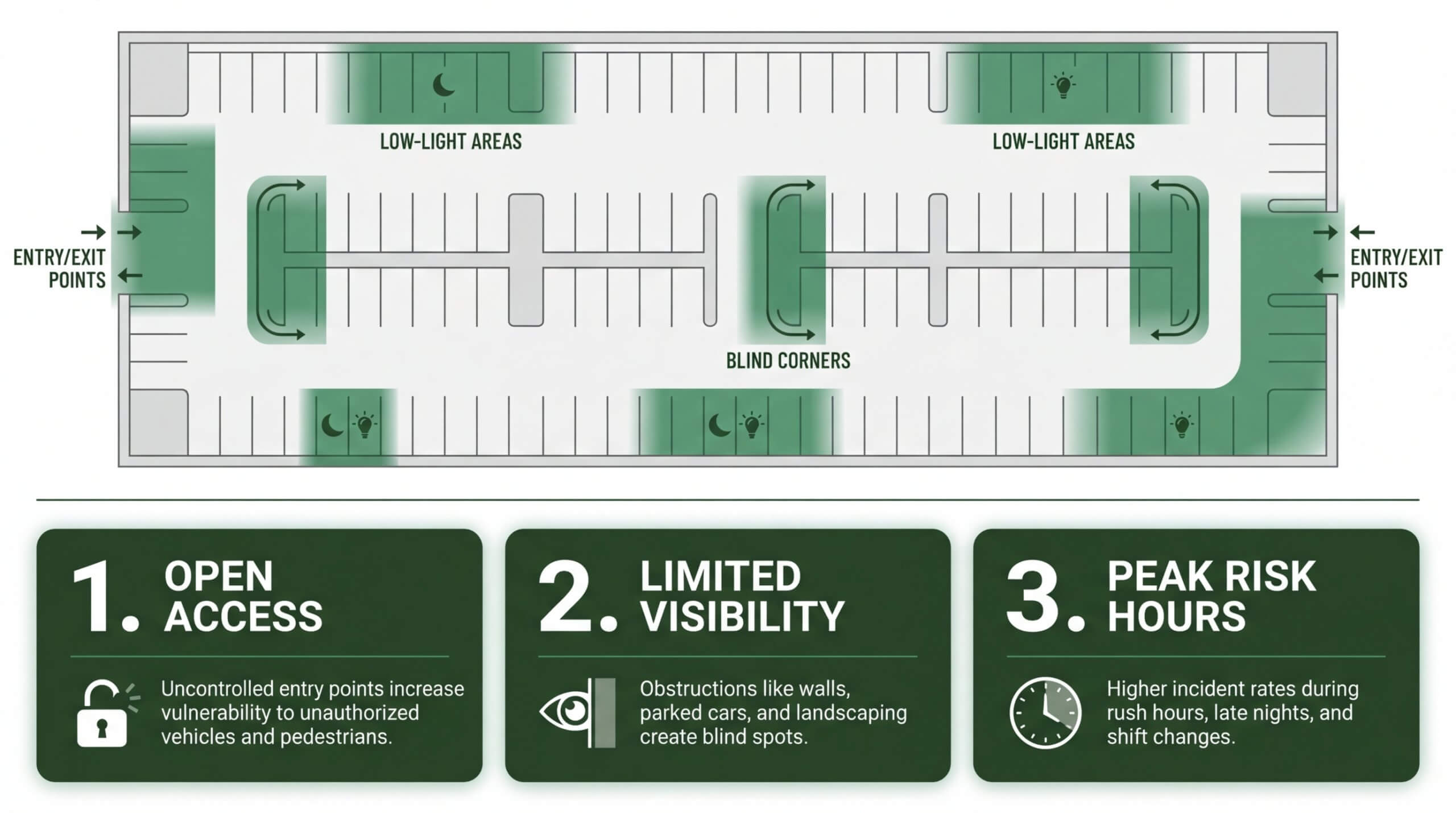
Cameras should be positioned at every vehicle entry and exit point, along perimeter fence lines, at pedestrian walkways, and at interior intersections between parking rows. Mounting height matters considerably; cameras installed between 12 and 15 feet capture wider fields of view while remaining difficult to tamper with.
Corner-mounted cameras covering diagonal sightlines reduce the total units needed by maximizing each camera’s coverage area. Overlapping fields of view between adjacent cameras eliminate blind spots where incidents could go unrecorded. Lighting conditions also influence placement, so pairing cameras with dedicated LED illuminators ensures consistent image quality after dark. For most commercial properties, prioritizing high-traffic zones and areas with limited natural surveillance yields the strongest deterrent effect.
Do 4K Cameras Improve Identification and Evidence Quality?
4K cameras significantly improve identification and evidence quality by capturing four times the pixel density of standard 1080p systems. This higher resolution allows security teams to zoom into footage and still identify facial features, license plate numbers, and clothing details with clarity.
For parking lot applications, where subjects may be 50 to 100 feet from the lens, 4K resolution preserves critical detail that lower-resolution cameras lose at distance. Law enforcement agencies increasingly prefer 4K footage because it produces court-admissible evidence with sharper subject identification. The tradeoff involves greater storage and bandwidth requirements, though modern compression and cloud-based solutions have made 4K systems practical for most commercial installations.
With strategic camera placement established, understanding how parking lot security affects business liability clarifies the financial case for these investments.
How Does Parking Lot Security Affect Business Liability and Insurance?
Parking lot security affects business liability and insurance by determining whether a property owner meets the legal duty of care owed to visitors. Inadequate security measures can expose businesses to negligent security claims, higher premiums, and nuclear verdicts.
Negligent security falls under premises liability, which holds property owners responsible when someone is injured by a third party’s criminal act on their property. According to the Insurance Information Institute, these lawsuits arise when a business fails to implement reasonable protective measures in areas it controls, including parking lots. Courts increasingly evaluate whether the property owner could have foreseen criminal activity based on prior incidents, neighborhood crime data, and existing security infrastructure.
The “foreseeability” standard has expanded significantly in recent years. Munich Re reports that property owners are seeing more litigation result in nuclear verdicts and large settlements, with courts broadening premises liability to include foreseeability of criminal acts on the property. This trend means businesses that operate high-traffic parking facilities without monitored security systems face growing legal and financial exposure.
Documented video monitoring serves a dual protective function. It deters incidents that would generate claims while simultaneously producing timestamped evidence that demonstrates the business took reasonable precautions. Insurers often view proactive surveillance favorably when assessing risk profiles, which can influence premium calculations and coverage terms.
For businesses weighing security investments, the cost of a monitored system is typically a fraction of a single premises liability settlement. Proactive parking lot security is one of the most cost-effective risk mitigation strategies available, especially for properties with high foot traffic or documented incident histories. Understanding this liability landscape helps frame the financial returns that video monitoring delivers.
What ROI Can Businesses Expect From Video Monitoring in Parking Lots?
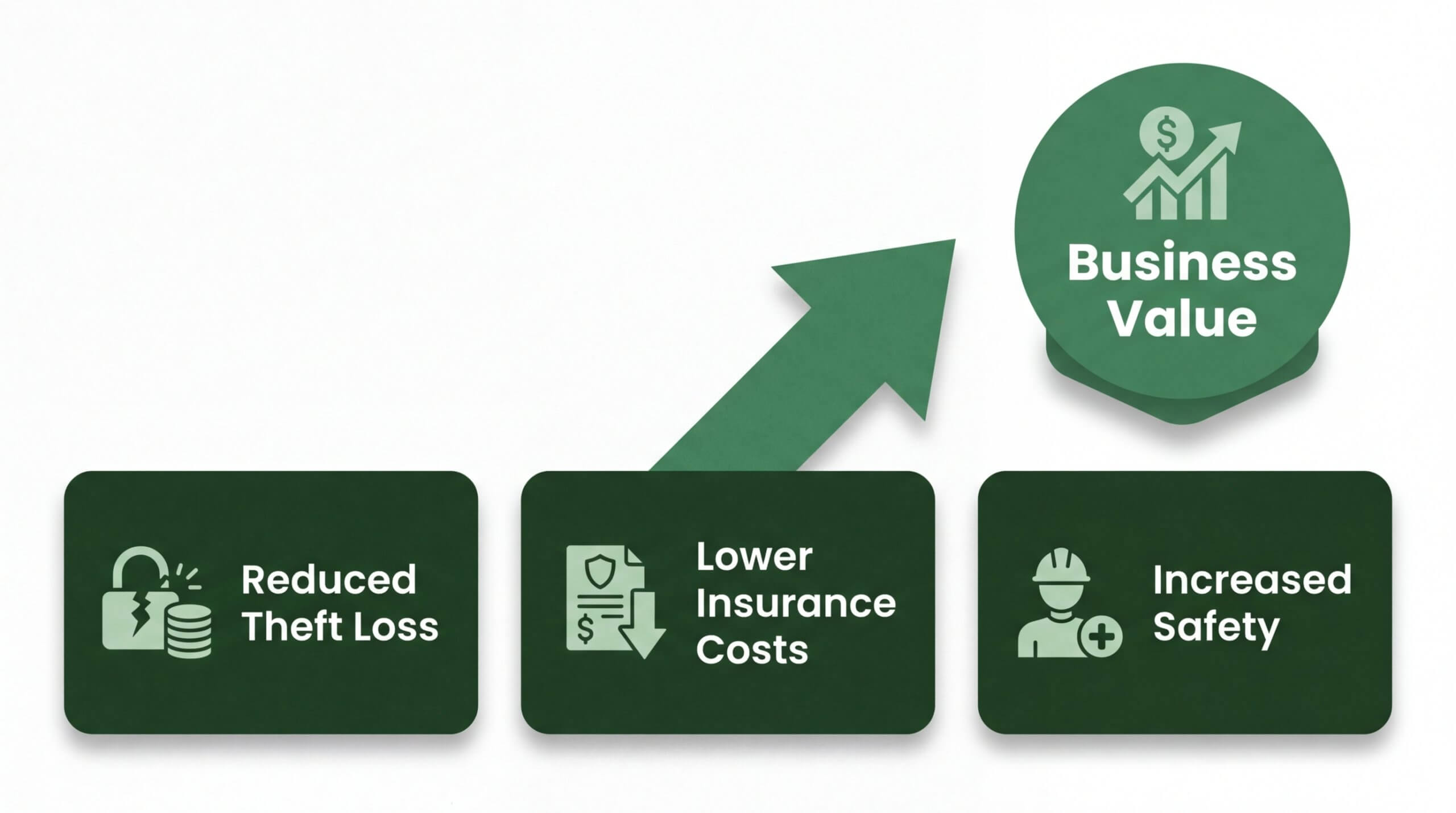
Businesses can expect ROI from video monitoring in parking lots through reduced theft losses, lower insurance premiums, decreased liability exposure, and increased customer retention. These returns compound over time as incident rates drop and operational costs stabilize.
The most immediate financial return comes from preventing vehicle theft and property damage. With nearly 23.7 percent of car thefts occurring in parking lots or garages, according to the Urban Institute, each prevented incident eliminates costs tied to insurance claims, police reports, and potential lawsuits. A single vehicle break-in can trigger thousands in direct losses before accounting for reputational damage that drives customers elsewhere.
Liability reduction represents another measurable return. As Munich Re has reported, property owners face expanding premises liability standards, including “foreseeability” of criminal acts that can result in nuclear verdicts and large settlements. Documented video monitoring demonstrates reasonable security measures, which strengthens legal defenses and can reduce settlement exposure significantly.
Insurance carriers often recognize proactive monitoring systems when calculating premiums. Properties with verified, active surveillance typically qualify for lower rates compared to sites relying solely on passive recorded cameras. Over a multi-year period, these premium reductions alone can offset a substantial portion of monitoring costs.
Customer confidence drives revenue retention that rarely appears on a balance sheet but directly impacts profitability. When shoppers, tenants, or employees feel safer, they return more frequently and stay longer. For most commercial properties, the cost of losing even a small percentage of regular visitors to safety concerns far exceeds the investment in professional monitoring.
From a practical standpoint, video guard monitoring often costs a fraction of staffing on-site security guards across multiple shifts while delivering broader, more consistent coverage. This cost efficiency, combined with measurable reductions in incidents, liability payouts, and insurance expenses, makes the ROI case compelling for properties of nearly any size. Understanding these financial returns sets the stage for exploring how AI-powered monitoring amplifies these benefits further.
How Can AI-Powered Live Video Monitoring Strengthen Your Parking Lot Security?
AI-powered live video monitoring strengthens parking lot security by combining intelligent threat detection with real-time human intervention. Pioneer Security’s Remote Video Guard service and key takeaways are covered below.
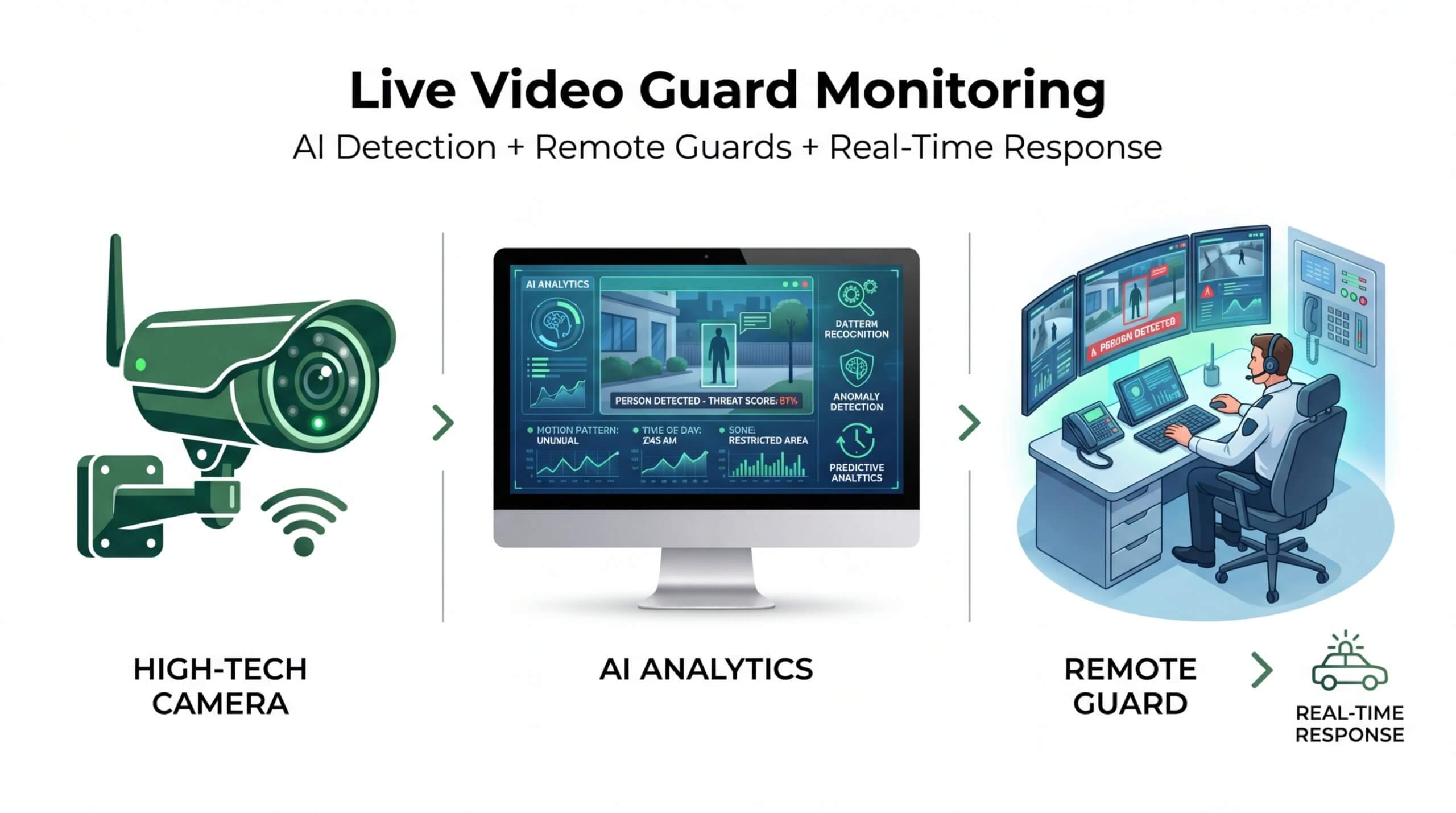
Can Pioneer Security’s Remote Video Guard Service Protect Your Parking Lot?
Yes, Pioneer Security’s Remote Video Guard service can protect your parking lot through AI-powered live video monitoring that detects and deters threats before incidents escalate. The system pairs Nvidia GPU-powered analytics with US-based human guards who intervene in real time using 2-way audio, sirens, and strobe lights.
A University of Tennessee study published in the International Journal of Nuclear Security confirms that remote video monitoring is increasingly using robotics and artificial intelligence to protect against malicious acts. Pioneer Security applies this approach through 4K/8MP cameras and intelligent detection hubs that verify threats instantly, enabling direct police dispatch from the monitored location. Founded in 1978, Pioneer Security brings over 45 years of experience to every parking lot security evaluation.
What Are the Key Takeaways About Video Guard Monitoring for Parking Lot Security?
The key takeaways about video guard monitoring for parking lot security are:
- Parking lots remain high-risk environments; according to the Bureau of Justice Statistics, about 19% of carjacking victimizations in 2021 occurred in a parking lot or garage.
- Live video monitoring outperforms recorded surveillance by enabling real-time intervention before crimes are completed.
- AI-powered analytics reduce false alarms and improve response accuracy through computer vision and deep learning.
- Proactive deterrence, including live audio warnings and visible camera placement, discourages criminal activity at the point of approach.
- Documented monitoring strengthens premises liability defense and may reduce insurance costs.
For most property managers, investing in live video guard monitoring is one of the highest-impact decisions available. Passive cameras alone simply cannot match the deterrent value of a system where trained guards respond in real time.