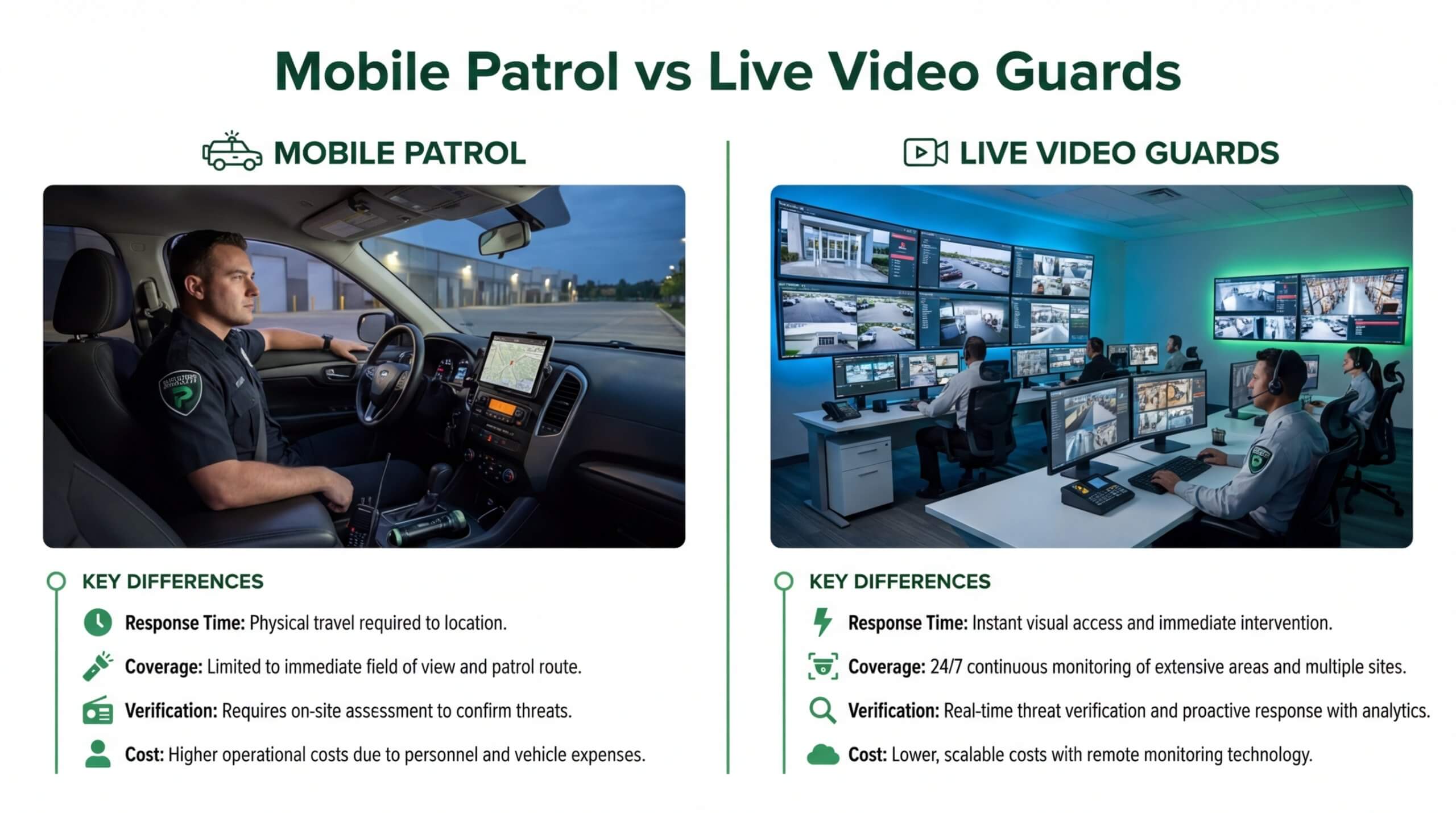
Mobile patrol security sends licensed guards on scheduled routes to inspect properties at set intervals, while live video monitoring pairs AI-powered cameras with trained human operators who watch feeds and respond to threats around the clock. Each model protects property through a fundamentally different mechanism: periodic physical presence versus continuous remote surveillance.
This guide covers how each security method operates, the core safety differences between them, the specific vulnerabilities each approach carries, which property types benefit most from each option, and how costs compare per hour of actual coverage.
Mobile patrol works through timed rounds where officers check locks, scan for suspicious activity, and document conditions at each stop. The gaps between visits, often 60 to 90 minutes, leave properties unmonitored, and even significant increases in patrol frequency produce only modest reductions in crime during those windows.
Live video monitoring eliminates coverage gaps by combining AI detection with real-time human intervention. When cameras flag unusual activity, operators verify the threat within seconds and activate two-way audio warnings, sirens, or direct police dispatch; all without requiring physical travel to the site.
The safety differences between the two models come down to response speed, simultaneous coverage area, and deterrent persistence. Live video guards respond in seconds from a remote center, while mobile patrol response depends on a guard’s physical location at the time of an incident.
Both approaches carry distinct limitations. Mobile patrol faces weather delays, traffic disruptions, and the physical vulnerability of a lone officer. Live video monitoring depends on hardware reliability and cannot place a human body on site. Combining both into a layered strategy addresses each gap directly.
What Is Mobile Patrol Security?
Mobile patrol security is a protective service where licensed security guards travel between properties on scheduled or randomized routes to deter crime through physical presence. This section covers its core definition and how it fits within the broader security landscape.
Mobile patrol security relies on uniformed officers conducting vehicle or foot patrols across designated areas. Guards inspect entry points, verify locks, identify suspicious activity, and document conditions at each stop. The service operates on timed intervals, meaning a property receives periodic check-ins rather than continuous on-site coverage.
Most mobile patrol contracts define specific visit frequencies, geographic zones, and reporting protocols. According to 2025 data from the Bureau of Justice Statistics, approximately 1.1 million people were employed as security guards in the United States, reflecting the scale of physical guard services nationwide. Roving patrol posts typically require guards to conduct foot or vehicle patrols within or between assigned geographic areas, a structure formalized in contracts like those used by Loudoun County, Virginia.
For properties that need a visible human deterrent at regular intervals, mobile patrol remains a practical option. However, the gaps between visits create windows where no security personnel are present, a limitation that becomes critical when comparing this approach to continuous monitoring alternatives.
What Is a Live Video Guard?
A live video guard is a trained security operator who monitors property cameras in real time from a remote command center. Unlike passive CCTV that simply records footage, this approach pairs human judgment with AI-powered detection to identify and respond to threats as they unfold.
According to the U.S. Department of Homeland Security, video analytics software uses computer algorithms to monitor real-time video captured by security cameras, enhancing surveillance of people, vehicles, objects, and their associated behaviors within a camera’s view. Live video guards use this technology as their foundation, adding human decision-making on top of automated alerts. When AI detects unusual activity, the operator verifies the threat, issues voice warnings through two-way audio speakers, activates sirens or strobes, and contacts law enforcement if needed. This combination of continuous AI scanning and immediate human intervention makes live video monitoring a fundamentally proactive security model, one designed to stop incidents before damage occurs rather than review footage after the fact.
How Does Mobile Patrol Security Work?
Mobile patrol security works by dispatching trained guards on scheduled routes to inspect properties, check entry points, and document conditions. The sections below cover what occurs during each patrol round and what happens in the gaps between visits.
What Happens During a Scheduled Mobile Patrol Round?
During a scheduled mobile patrol round, a security officer drives or walks a predetermined route through the property, performing a series of physical checks. The guard typically inspects perimeter fences, locks doors, scans for unauthorized vehicles, and looks for signs of forced entry or vandalism.
Each checkpoint is logged with a timestamp and location data, creating an auditable trail. Officers may also verify that lighting, alarms, and fire safety systems are functioning. If they discover an issue, they document it and either address it on-site or escalate to law enforcement.
This hands-on process provides a visible human presence, though coverage is limited to the time the officer is physically on the property.
What Happens Between Mobile Patrol Visits?
Between mobile patrol visits, the property is left without active on-site security monitoring. This interval, which can range from one to several hours depending on the patrol schedule, represents an unmonitored window where incidents can occur undetected.
A study published in PLOS ONE found that 41% more patrol visits and 29% more time spent by security agents at treatment locations led to only a 16% reduction in victim-generated crimes, suggesting that even significantly increased patrol frequency cannot eliminate coverage gaps entirely.
During these intervals, the property relies on passive measures like locks, fencing, and alarm systems. Any intrusion or damage that occurs between rounds may not be discovered until the next scheduled visit. For properties requiring continuous protection, this gap is a critical vulnerability worth evaluating against always-on monitoring alternatives.
How Does Live Video Monitoring Work?
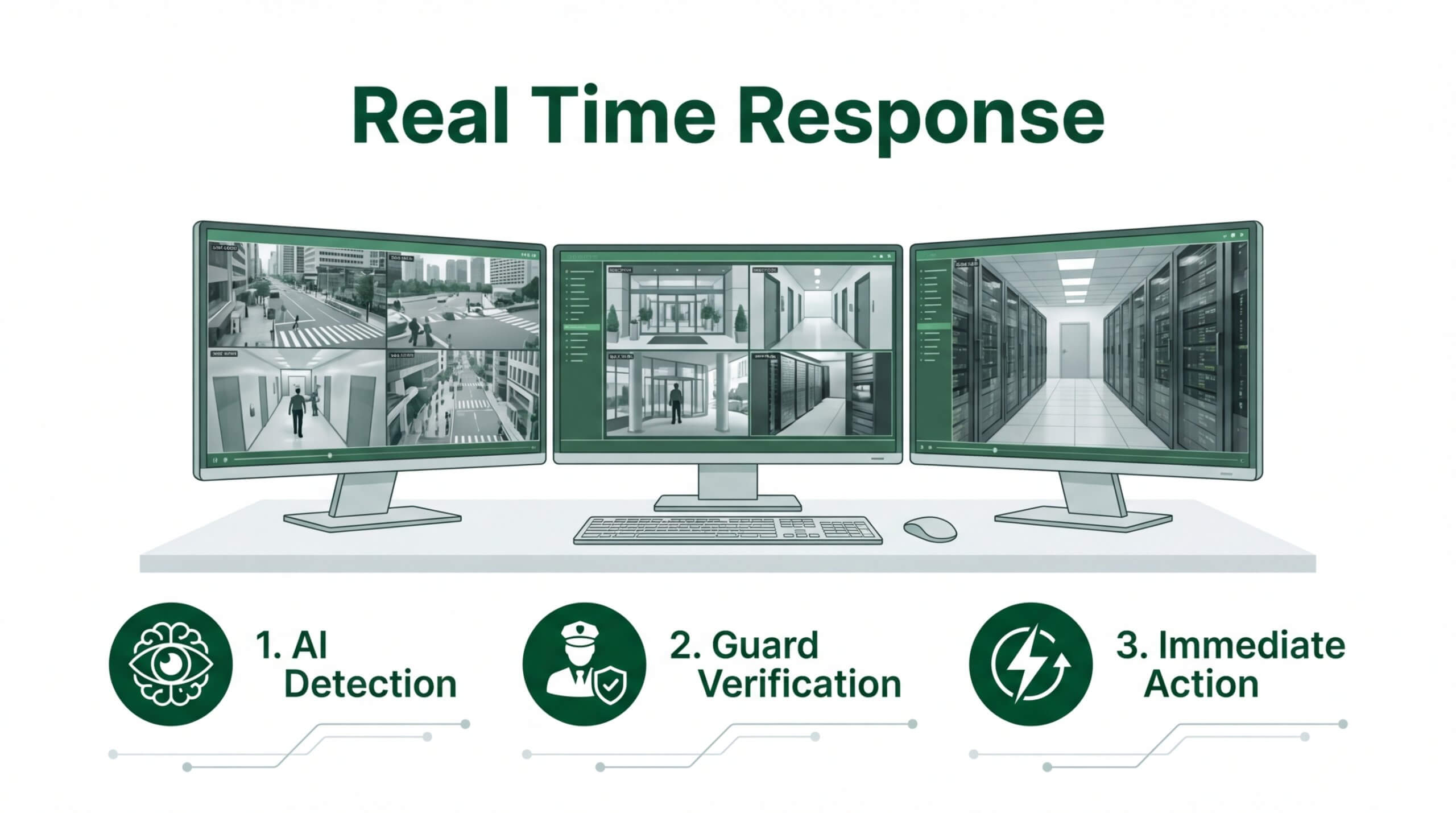
Live video monitoring works by combining AI-powered camera systems with trained human operators who watch feeds and respond to threats as they happen. The process involves two key stages: automated detection and live guard intervention.
How Does AI Detection Trigger a Live Video Guard Response?
AI detection triggers a live video guard response by using computer algorithms to analyze camera feeds continuously for unusual activity. When the system identifies a potential threat, such as unauthorized movement, perimeter breaches, or loitering after hours, it instantly sends an alert to a remote monitoring center. A trained operator then reviews the flagged event on screen within seconds. This eliminates the delay of traditional alarm systems, where notifications sit in a queue before anyone evaluates them. The AI handles the constant surveillance burden, filtering out false triggers like animals or shifting shadows, so human guards focus only on verified events that require action.
How Do Live Video Guards Intervene in Real Time?
Live video guards intervene in real time by assessing the verified alert, activating deterrents, and coordinating emergency response from a remote command center. Once an operator confirms a genuine threat on camera, intervention follows a rapid sequence:
- The guard issues a live voice warning through two-way audio speakers directed at the intruder.
- Sirens and strobe lights activate simultaneously to create an immediate deterrent effect.
- If the individual does not leave, the guard contacts local law enforcement with verified visual confirmation of a crime in progress.
According to the U.S. Department of Homeland Security, video analytics software uses computer algorithms to monitor real-time video captured by security cameras, enhancing surveillance of people, vehicles, objects, and their associated behaviors within a camera’s view. This technology gives live video guards the contextual awareness to make faster, better-informed decisions than a patrol officer arriving without visual intelligence.
Providing verified incidents directly to police dispatchers significantly improves the priority and speed of law enforcement response, which is where live monitoring creates its strongest safety advantage over passive alarm systems. Understanding this real-time process reveals how the safety profile of live video guards compares to mobile patrol.
What Are the Main Safety Differences Between Mobile Patrol and Live Video Guards?
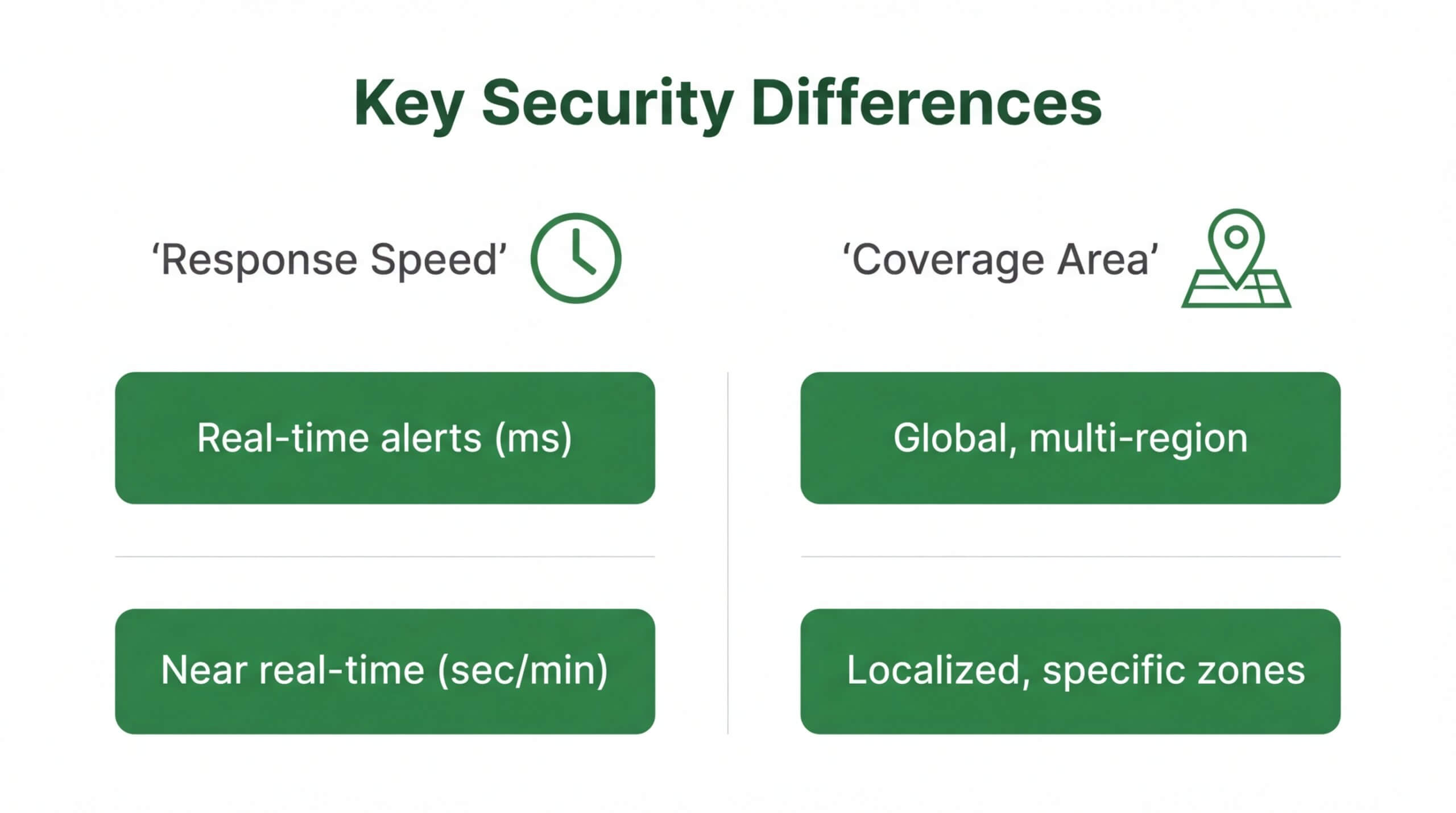
The main safety differences between mobile patrol and live video guards center on response speed, coverage area, and deterrent visibility. The subsections below compare each factor side by side.
How Quickly Can Mobile Patrol Respond to an Incident?
Mobile patrol can respond to an incident only after a guard physically travels to the location. Because patrol officers cover multiple properties on a rotating schedule, response depends on where the guard is when the alert occurs. Travel time, traffic conditions, and distance between sites all add delay. For facilities in county-level patrol contracts, guards conduct foot or vehicle patrols across assigned geographic areas, which means any single property may wait until the next scheduled visit. This gap between detection and arrival is the core speed limitation of mobile patrol as a standalone solution.
How Quickly Can a Live Video Guard Respond to an Incident?
A live video guard can respond to an incident within seconds of an AI-triggered alert. Because monitoring happens remotely through continuous camera feeds, no physical travel is required before the initial intervention. The guard verifies the threat on screen and activates two-way audio, sirens, or strobe lights almost immediately. When police dispatch is needed, verified alerts bypass the delays common with unverified alarms. This instant verification-to-action sequence is what separates live video response from patrol-dependent models.
How Much Ground Can Mobile Patrol Cover at One Time?
Mobile patrol can cover only the ground where the guard is physically present at any given moment. A single officer patrols one location while every other assigned property remains unattended. Even with optimized routes, a patrol vehicle moves sequentially between sites. Larger campuses or multi-building facilities compound this limitation because the guard cannot observe areas behind them. Coverage, in practical terms, equals one pair of eyes in one place at one time.
How Much Ground Can Live Video Monitoring Cover at One Time?
Live video monitoring can cover an entire property simultaneously through networked camera arrays. Multiple cameras feed into a centralized monitoring station where trained guards observe every angle at once. According to The Monitoring Association, traditional alarm notifications requiring multiple voice calls between emergency communications centers and alarm-monitoring centers add an average of six to eight minutes to response times. Live video monitoring eliminates that delay by providing instant visual verification, removing the call-relay bottleneck entirely. For large or multi-zone properties, this simultaneous coverage represents a fundamental advantage over sequential patrol models.
How Visible Is Mobile Patrol as a Deterrent?
Mobile patrol is visible as a deterrent only during the moments a marked vehicle or uniformed officer is physically on site. The presence of a patrol car, branded signage, and a uniformed guard creates a strong but temporary visual warning. Once the vehicle leaves, the deterrent effect fades until the next scheduled visit. This intermittent visibility can still discourage opportunistic crime, particularly when patrol timing is unpredictable. However, determined intruders who observe patrol patterns can time their approach for the gaps between visits.
How Visible Is a Live Video Guard System as a Deterrent?
A live video guard system is visible as a deterrent around the clock through permanently installed cameras, warning signage, and active audio capabilities. The U.S. Department of Justice defines video security systems as an integrated system consisting of video cameras, monitors, recorders, and other components used for surveillance and security purposes. Visible camera housings and “monitored property” signs signal constant observation. When an intruder approaches, real-time voice warnings through two-way speakers confirm that a live person is watching. This persistent, active deterrent presence does not depend on patrol schedules or physical proximity, making it effective even during overnight hours when properties are most vulnerable.
With these safety differences outlined, understanding the specific gaps in each approach helps determine which solution fits a given property.
What Are the Biggest Security Gaps with Mobile Patrol?
The biggest security gaps with mobile patrol are coverage interruptions between rounds, weather and traffic delays, and the physical vulnerability of a lone guard. Each gap creates windows that criminals can predict and exploit.
What Happens When a Property Is Unmonitored Between Patrols?
When a property is unmonitored between patrols, it becomes an open target during predictable gaps. Most mobile patrol routes cycle every 60 to 90 minutes, leaving long stretches with zero on-site presence. Criminals who observe patrol timing can act within these windows and leave before the next round begins.
A study published in PLOS ONE found that 41% more patrol visits and 29% more minutes spent by security agents at treatment locations led to only a 16% reduction in victim-generated crimes. Even significantly increased patrol frequency cannot eliminate the vulnerability that exists between visits. For properties storing high-value assets, these unmonitored intervals represent the single most exploitable weakness in a mobile patrol strategy.
How Does Weather or Traffic Affect Mobile Patrol Reliability?
Weather and traffic directly reduce mobile patrol reliability by delaying arrival times and disrupting scheduled routes. Heavy rain, fog, ice, and flooding slow vehicle travel and limit a guard’s ability to conduct thorough exterior inspections on foot. Urban congestion during peak hours can push patrol intervals well beyond their intended schedule.
These delays are difficult to track without real-time oversight. According to an ASIS International survey, 80 percent of security professionals reported that security incidents were a top metric shared with C-suite personnel, yet few organizations measure patrol timing consistency with the same rigor. When conditions degrade, the gap between scheduled and actual coverage widens silently, leaving properties exposed without any alert to stakeholders.
How Vulnerable Is a Single Guard to Physical Threats?
A single guard is highly vulnerable to physical threats because mobile patrol officers typically work alone across multiple locations at night. One person can be overwhelmed, ambushed, or physically overpowered, particularly at remote or poorly lit sites. Armed confrontations, coordinated trespassing groups, and aggressive individuals all pose risks that a solo officer cannot safely manage.
This vulnerability also creates a deterrence ceiling. Research published in the Journal of Quantitative Criminology confirms that increasing patrol frequency in hotspots reduces crime, but frequency alone cannot compensate for the physical limitations of one person responding to a dangerous situation. The guard’s safety becomes a liability rather than an asset when threats escalate beyond what a single individual can handle.
With these gaps in mind, understanding live video monitoring’s limitations provides a complete picture for comparing both options.
What Are the Biggest Security Gaps with Live Video Monitoring?
The biggest security gaps with live video monitoring involve hardware dependency and the absence of a physical presence on site. These limitations affect how the system performs during outages and active threats.
What Happens If Cameras Lose Power or Connectivity?
Cameras that lose power or connectivity create a complete surveillance blackout for the affected zone. Without an active feed, live video guards cannot detect, verify, or respond to threats in that area. Common causes include severe weather, vandalism to cables, internet service outages, and power grid failures.
Backup systems reduce this risk significantly:
- Uninterruptible power supplies (UPS) keep cameras running during short outages.
- Cellular failover connections maintain video feeds when primary internet drops.
- Battery-backed PoE hubs sustain AI-powered analytics during power interruptions.
Redundancy planning is what separates a vulnerable camera setup from a reliable surveillance operation. Properties that skip backup power and secondary connectivity are essentially unguarded the moment conditions change.
Can Live Video Guards Physically Intervene on Site?
No, live video guards cannot physically intervene on site. They operate from remote monitoring centers, observing feeds and responding through digital tools rather than hands-on action. Their intervention methods include two-way audio warnings, siren and strobe activation, and direct police dispatch from the property’s address.
This limitation matters most during active physical threats, such as forced entry in progress or confrontations on the premises. A remote operator can escalate to law enforcement, but cannot physically detain or block an intruder. According to The Monitoring Association, traditional alarm notifications requiring multiple voice calls between emergency communications centers and alarm-monitoring centers add an average of six to eight minutes to response times, which highlights why verified video alerts that bypass extra call steps improve dispatch speed.
For properties facing high physical-threat risks, pairing live video monitoring with on-site security personnel closes this gap effectively.
Which Properties Benefit Most from Mobile Patrol?
The properties that benefit most from mobile patrol are those where physical presence, unpredictable timing, and on-the-ground response outweigh the need for continuous surveillance. These include staffed facilities, gated communities, and multi-site operations.
Mobile patrol works best when a property already has some baseline security infrastructure but needs a visible human deterrent to supplement it. Facilities with occupied buildings during business hours, existing access control systems, or on-site staff who can serve as eyes between patrol visits gain the most value from scheduled rounds. Conversely, properties that sit vacant for long stretches, such as overnight construction yards or unstaffed lots, face significant coverage gaps when relying on patrol alone.
The property types that gain the strongest return from mobile patrol include:
- Gated residential communities need patrol vehicles moving through neighborhoods at varied intervals to deter opportunistic crimes like package theft and vehicle break-ins.
- Office parks and corporate campuses with daytime occupants benefit from after-hours patrol rounds that verify locked doors, check perimeters, and confirm alarm integrity.
- Retail shopping centers use mobile patrol to cover large parking areas, respond to tenant alarms, and provide a visible uniformed presence during peak hours.
- Multi-location businesses with several nearby sites can schedule a single patrol route to check each property, reducing per-location cost while maintaining regular physical inspections.
- Industrial facilities with active shifts already have workers on site who notice irregularities; patrol rounds between shift changes fill the vulnerability window.
A study published in the Journal of Quantitative Criminology found that increasing the frequency of patrols in crime hotspots leads to a significant reduction in crime without causing spatial spillover, which reinforces why properties clustered in higher-risk areas see measurable benefit from regular mobile rounds.
For properties that lack on-site staff or need around-the-clock monitoring without gaps, live video guards often provide stronger protection.
Which Properties Benefit Most from Live Video Guards?
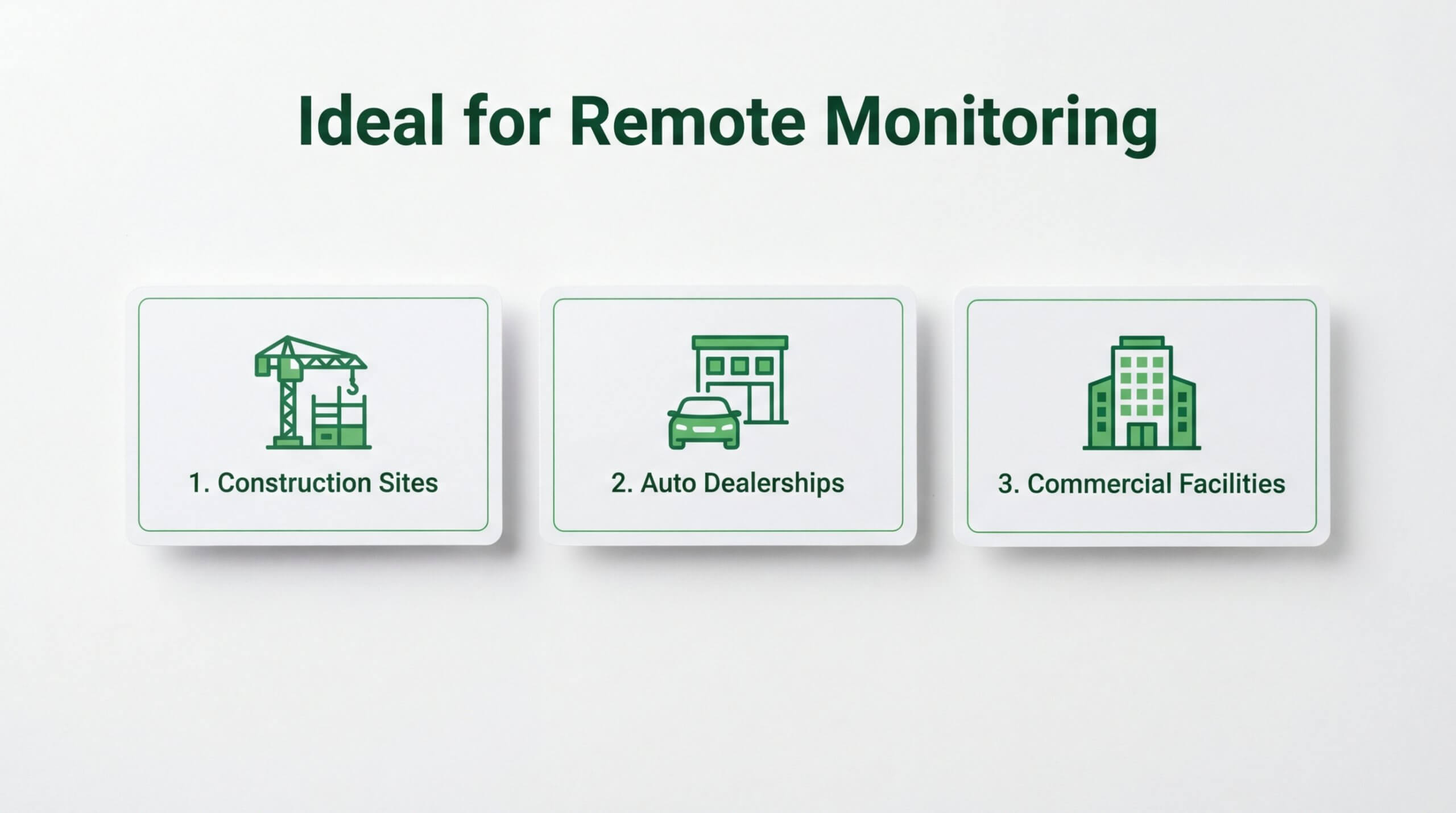
Properties with high-value assets, large perimeters, and after-hours vulnerability benefit most from live video guards. Construction sites, auto dealerships, and commercial facilities each gain distinct advantages from continuous remote monitoring.
Why Are Construction Sites Safer with Live Video Guards?
Construction sites are safer with live video guards because these properties face unique overnight vulnerability when workers leave and expensive materials remain exposed. Heavy equipment, copper wiring, and raw materials sit in open or partially fenced areas, making them easy targets during unmonitored hours.
Live video monitoring eliminates the gap between patrol visits by providing continuous surveillance across sprawling, changing layouts. AI-powered cameras detect motion at perimeter breaches, and operators issue real-time audio warnings before theft or vandalism occurs. According to the National Institute of Justice, CCTV implementation in targeted areas can reduce crime by up to 51%, a figure especially relevant for isolated job sites where physical patrols cannot maintain constant presence. For properties where the layout shifts weekly as construction progresses, fixed camera repositioning paired with remote monitoring adapts faster than static patrol routes.
Why Are Auto Dealerships Safer with Live Video Guards?
Auto dealerships are safer with live video guards because large open lots filled with high-value inventory create a security challenge that periodic patrols cannot fully address. Vehicles spread across acres of exposed space present multiple entry points for catalytic converter theft, vandalism, and break-ins.
Live video guards monitor every row and corner simultaneously through networked camera coverage. Two-way audio intervention deters would-be thieves the moment suspicious activity appears on screen, often before any vehicle is touched. This real-time capability matters most during overnight and weekend hours when dealerships are closed yet inventory remains fully exposed. The combination of AI-triggered alerts and human verification reduces false alarms while ensuring genuine threats receive immediate response, including direct police dispatch with verified crime-in-progress status.
Why Are Commercial Facilities Safer with Live Video Guards?
Commercial facilities are safer with live video guards because warehouses, office parks, and distribution centers combine large footprints with multiple access points that a single patrol officer cannot watch simultaneously. Loading docks, parking structures, and rear entrances often go unmonitored between scheduled rounds.
Continuous remote monitoring covers every vulnerable zone at once. AI analytics detect unauthorized access, loitering, or vehicle intrusions across the entire property and alert live operators within seconds. This persistent coverage proves especially valuable for facilities operating outside standard business hours, where internal theft and unauthorized entry risks increase. For most commercial properties, the ability to verify and escalate threats in real time represents a fundamentally stronger security posture than intermittent physical presence alone.
With property-specific advantages established, the next consideration is how costs compare between these security models.
How Do Mobile Patrol and Live Video Guard Costs Compare?
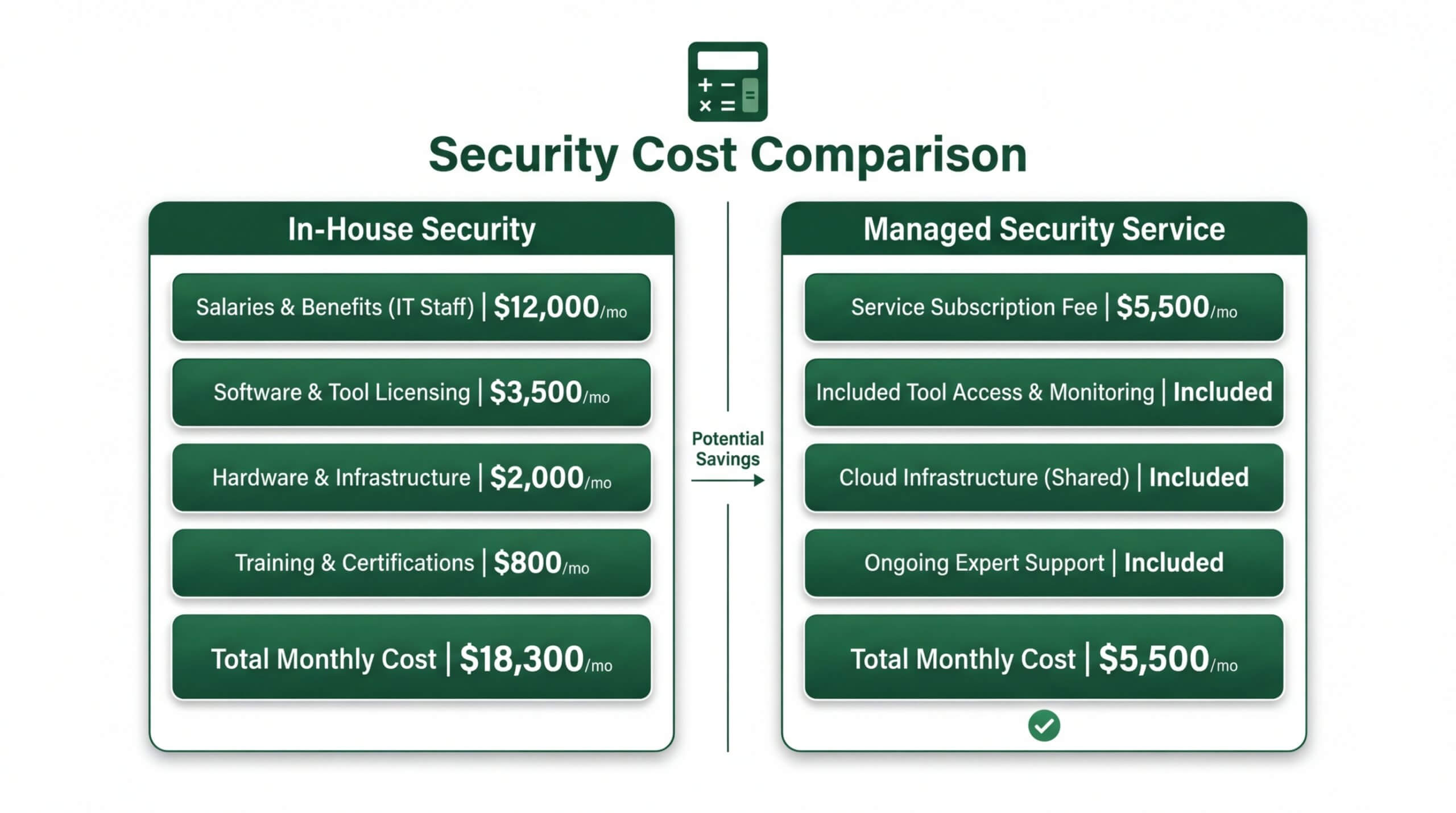
Mobile patrol and live video guard costs differ significantly in monthly expense and per-hour value. The sections below break down typical monthly pricing for each option and reveal which delivers better cost per hour of coverage.
What Does Mobile Patrol Typically Cost per Month?
Mobile patrol typically costs between $1,500 and $4,000 per month for most commercial properties. Pricing depends on visit frequency, route length, and time spent on site per check. A standard contract might include two to four visits per night, with each patrol lasting 15 to 30 minutes. That schedule leaves hours of uncovered time between rounds.
Additional charges often apply for holiday coverage, after-hours callouts, or extended dwell times. Fuel surcharges and vehicle maintenance costs are frequently passed through to the client as well. For properties requiring more frequent checks, monthly costs can climb well above $5,000 without achieving continuous protection.
What Does Live Video Monitoring Typically Cost per Month?
Live video monitoring typically costs between $500 and $2,500 per month, depending on camera count and monitoring hours. Most providers bundle AI-powered detection with US-based live video guards who watch feeds around the clock. Initial equipment investment for cameras, AI hubs, and installation ranges from $5,000 to $20,000, though this one-time cost amortizes over the system’s lifespan.
Unlike mobile patrol, the monthly fee covers continuous surveillance with no gaps between visits. Properties with higher camera counts pay more, but each additional camera extends coverage without adding proportional labor costs. This scalability makes live video monitoring particularly efficient for larger sites.
Which Option Delivers Better Cost per Hour of Coverage?
Live video monitoring delivers significantly better cost per hour of coverage than mobile patrol. According to 2023 Bureau of Labor Statistics data, the mean hourly wage for a security officer was $17.82 per hour, resulting in a fully burdened cost of approximately $24.95 per hour after accounting for a standard 40 percent markup for benefits and overhead.
A single mobile patrol guard working eight hours costs roughly $200 per night at that burdened rate, yet covers only a fraction of those hours on any one property. Live video monitoring, priced around $1,500 monthly, provides 720 hours of continuous coverage, bringing the effective rate to approximately $2 per hour. That makes live video monitoring roughly twelve times more cost-efficient per hour of actual surveillance.
For most properties, this cost gap makes live video guards the stronger investment per dollar spent on active protection.
Can You Combine Mobile Patrol with Live Video Monitoring?
Yes, you can combine mobile patrol with live video monitoring, and doing so creates a layered security strategy that addresses the individual weaknesses of each approach. Live video guards provide continuous surveillance and instant detection, while mobile patrol adds a physical presence for on-site response.
When integrated, AI-powered cameras detect threats in real time and alert both a live video guard and the nearest patrol unit simultaneously. This eliminates the coverage gaps that occur between scheduled patrol rounds and compensates for the fact that remote monitors cannot physically intervene. The video system serves as the persistent eyes across every camera angle, and the patrol officer becomes the rapid-response component dispatched only when verified incidents require a physical presence.
For properties with large perimeters or high-value assets, this combination often delivers stronger protection than doubling down on either solution alone. The video layer reduces false dispatches by verifying threats before mobilizing a guard, which keeps patrol resources focused on genuine incidents. With layered security as the foundation, the next step is matching the right solution to your specific property type and risk profile.
How Should You Choose the Right Security Solution for Your Property?
You should choose the right security solution for your property by evaluating your site’s specific vulnerabilities, coverage needs, and budget. The sections below cover Pioneer Security’s AI-powered live video guard capabilities and the key takeaways from the mobile patrol vs live video guard comparison.
Can Pioneer Security’s AI-Powered Live Video Guards Protect Your Property Around the Clock?
Yes, Pioneer Security’s AI-powered live video guards can protect your property around the clock. The system pairs Nvidia GPU-powered AI detection with US-based human operators who monitor feeds 24/7, intervening through two-way audio, sirens, and strobe lights the moment a threat is identified. Pioneer Security dispatches 911 services directly from the business address, delivering verified-crime-in-progress alerts that receive priority police response. According to the Bureau of Labor Statistics, the mean hourly wage for a security officer reached $17.82 in 2023, yet Pioneer Security’s live video monitoring covers multiple camera zones simultaneously at a fraction of what staffing round-the-clock physical guards would cost. Founded in 1978, Pioneer Security brings over 45 years of experience to every installation.
What Are the Key Takeaways About Mobile Patrol vs Live Video Guard Safety?
The key takeaways about mobile patrol vs live video guard safety center on coverage continuity, response speed, and cost efficiency:
- Mobile patrol provides a visible physical presence that deters opportunistic crime, but leaves properties unmonitored between scheduled rounds.
- Live video guards deliver continuous surveillance with AI-triggered alerts, eliminating the coverage gaps inherent in patrol schedules.
- Response time favors live video monitoring because operators detect threats in real time and contact authorities immediately, while mobile units must travel to the scene first.
- Combining both solutions creates a layered defense where live video guards maintain constant watch and mobile patrol handles on-site physical response when needed.
For most commercial properties, live video monitoring offers the stronger baseline of protection. Pioneer Security can help you assess your site’s unique risks and design a solution that stops crime before it starts.