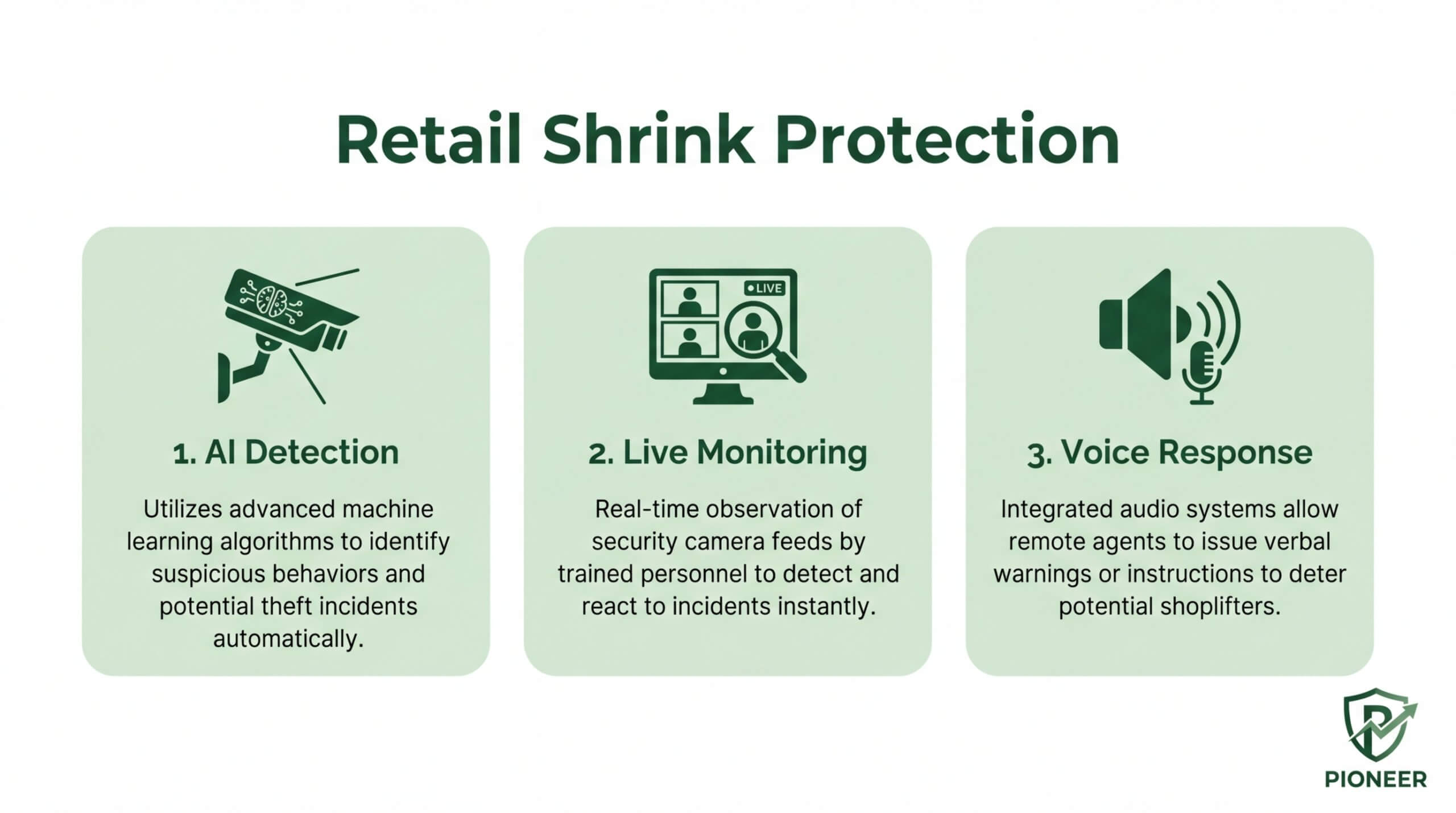
Retail shrink is the gap between recorded inventory and what is physically available for sale, and it cost the industry over $112 billion in 2022 alone. Retailers reduce this loss by deploying remote video guards: trained operators who monitor store cameras in real time, use AI-powered detection to flag threats, and intervene through live voice-down commands before theft is completed.
This guide covers the root causes of shrink, how remote video guard technology works, comparative effectiveness against traditional security methods, proactive deterrence strategies for both external and internal theft, high-risk store zones that benefit most from monitoring, and the ROI retailers can expect after deployment.
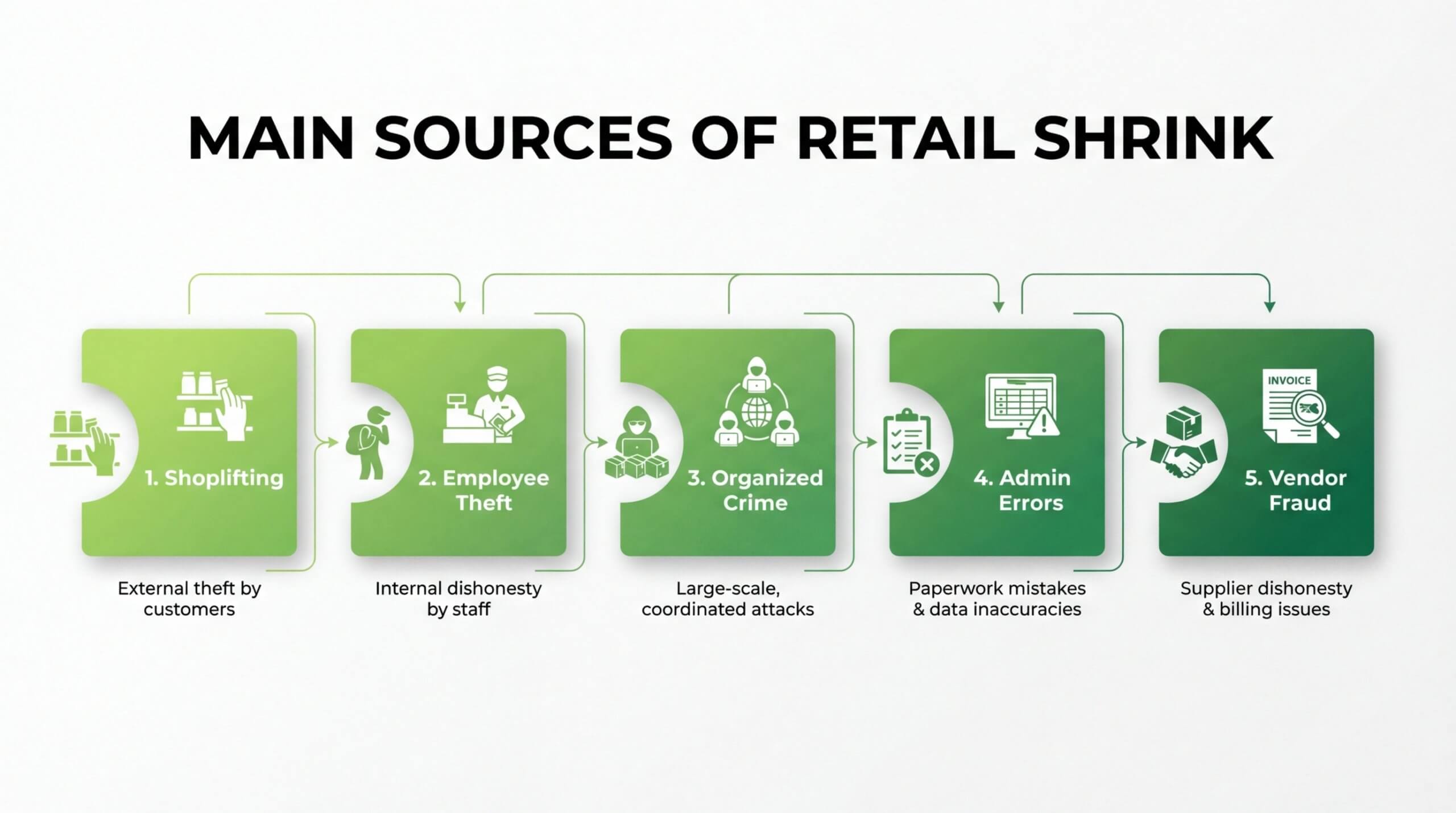
Shrink stems from five primary sources: shoplifting, employee theft, organized retail crime, administrative errors, and vendor fraud. Each erodes profit margins differently, and most losses accumulate gradually before detection.
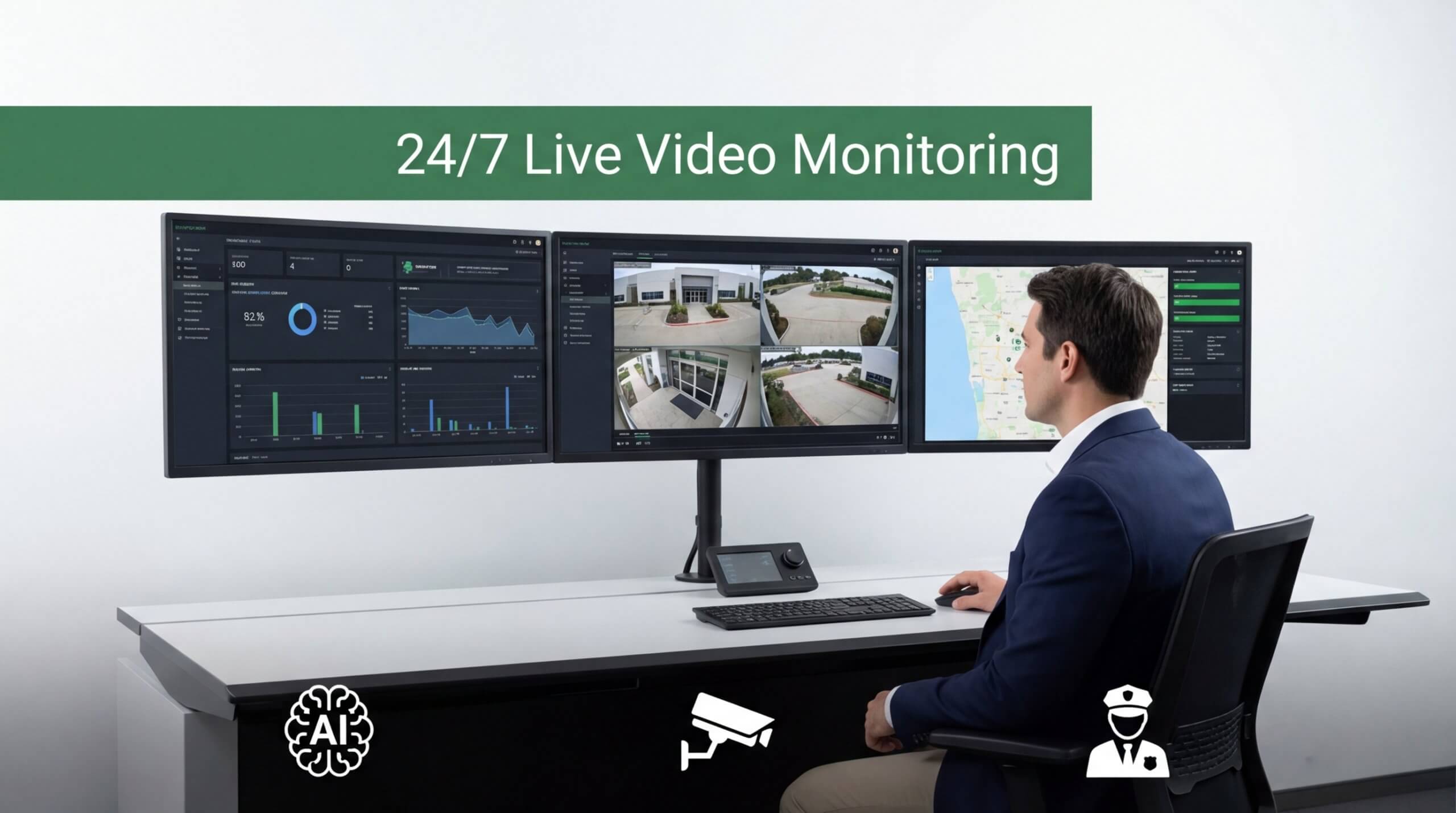
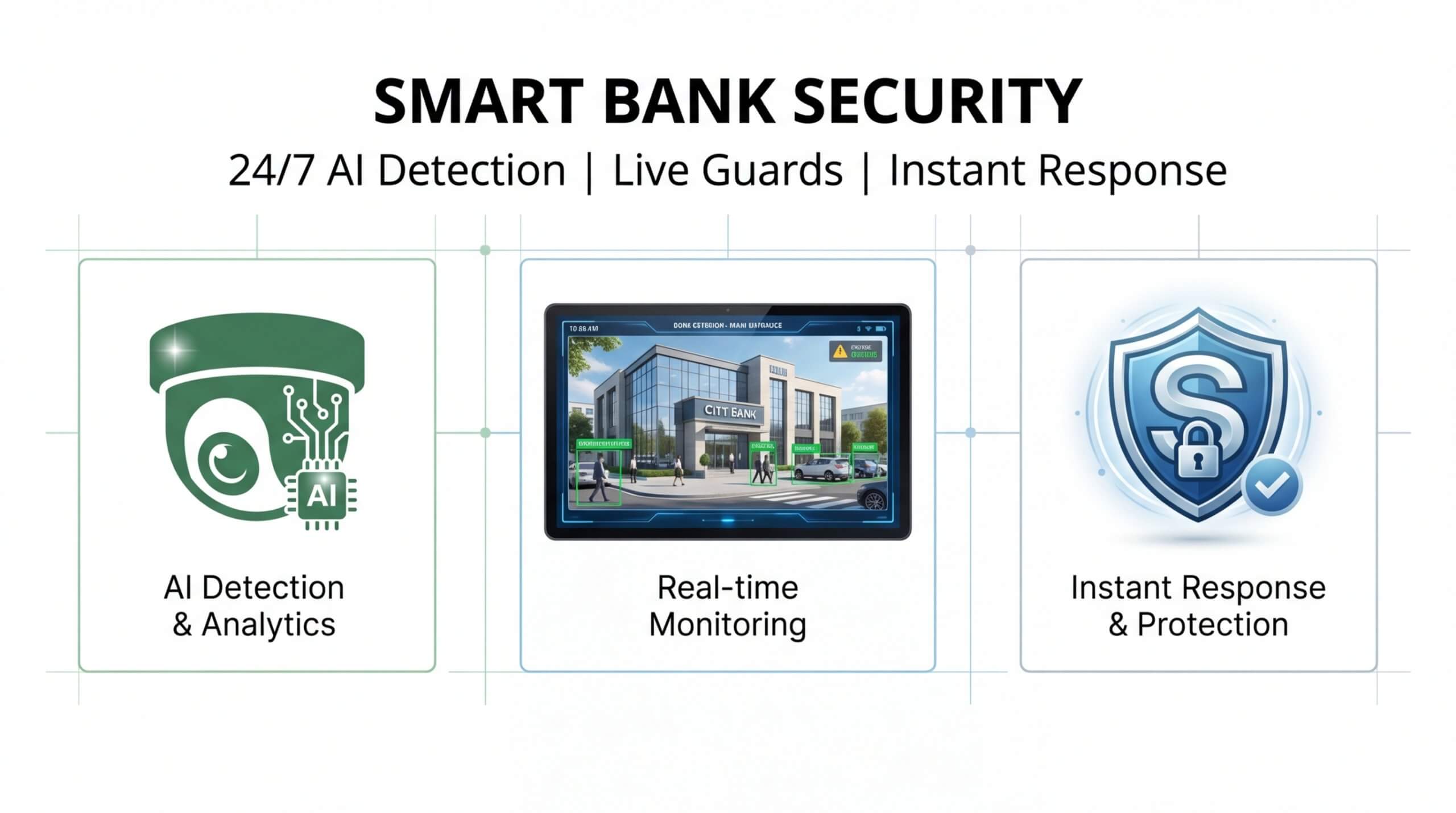
Remote video guards combine AI analytics, high-resolution cameras, and two-way audio systems staffed by live operators at centralized command centers. When AI flags suspicious activity, a human guard verifies the threat and responds within seconds through direct audio warnings, siren activation, or law enforcement dispatch.
Compared to on-site officers, passive CCTV, and alarm-only setups, remote guards deliver continuous multi-zone coverage at a fraction of the cost while resolving over 99% of incidents without police involvement.
Self-checkout stations, entrances, stockrooms, receiving docks, and parking lots represent the highest-risk zones. Live monitoring of these areas catches skip-scanning, unauthorized access, and after-hours trespassing in real time rather than on review weeks later.
Retailers typically see measurable shrink reduction within 30 to 90 days of deployment, with the steepest gains appearing in the first quarter as visible deterrence and AI detection work together.
What Is Retail Shrink and Why Does It Matter?
Retail shrink is the loss of inventory that occurs when the products a retailer has on record exceed what is physically available for sale. This gap between expected and actual inventory translates directly into lost revenue, eroding profit margins across every retail category.
The financial scale of shrink makes it one of the most pressing challenges in the industry. According to the National Retail Federation, shrink accounted for $112.1 billion in losses in 2022, up from $93.9 billion in 2021. That steep year-over-year increase signals a problem that is accelerating, not stabilizing.
Shrink matters because it compounds silently. Unlike a single large theft event, most inventory loss accumulates gradually through shoplifting, employee theft, organized retail crime, administrative errors, and vendor fraud. Each source chips away at profitability in ways that often go undetected until a physical inventory count reveals the damage. As Loss Prevention Magazine noted, “Shrink can lead to the downfall of a retail enterprise, directly eating into the lifeline of profit that keeps the company in business.”
Beyond the balance sheet, rising shrink forces retailers into difficult decisions:
- Higher consumer prices to offset losses.
- Store closures in high-theft locations.
- Reduced product availability that frustrates loyal customers.
- Increased spending on reactive security measures.
For most retailers, shrink is not a problem that solves itself. Without proactive detection and deterrence strategies, losses tend to grow each year. Understanding where shrink originates is the essential first step toward controlling it, which is why identifying its main causes deserves closer examination.
What Are the Main Causes of Retail Shrink?
The main causes of retail shrink are shoplifting, employee theft, organized retail crime, administrative errors, and vendor fraud. Each source erodes inventory and profit margins differently.
How Does Shoplifting Contribute to Retail Shrink?
Shoplifting contributes to retail shrink as the single largest source of external inventory loss. Individuals conceal merchandise, swap price tags, or walk out with unpaid goods, and these losses compound rapidly across locations.
According to the National Retail Federation, shrink accounted for $112.1 billion in losses in 2022, up from $93.9 billion in 2021. Shoplifting drives a significant share of that figure. Because many incidents go unreported or undetected, the true cost is likely higher than published estimates suggest. For retailers operating on thin margins, even modest shoplifting rates can eliminate net profit entirely.
How Does Employee Theft Drive Inventory Loss?
Employee theft drives inventory loss through methods such as cash skimming, unauthorized discounts, merchandise concealment, and fraudulent returns. Internal theft is particularly damaging because employees understand store procedures and blind spots.
According to a 2023 Embroker report on employee theft statistics, employees steal an average of $1,890 per incident from retailers, while only 10.9% of retail theft losses are typically recovered. That low recovery rate means most internal shrink becomes a permanent write-off. Consistent monitoring of point-of-sale activity and inventory handling is one of the most effective ways to discourage this behavior before losses accumulate.
How Does Organized Retail Crime Increase Shrinkage?
Organized retail crime increases shrinkage through coordinated, high-volume theft operations that target specific merchandise for resale. These groups use distraction techniques, booster bags, and multi-store sweeps that overwhelm traditional loss prevention.
According to a 2025 ASIS International report on external retail theft, external theft incidents increased 19 percent in 2024, and cargo or supply chain theft increased for 48 percent of retailers. Unlike opportunistic shoplifting, organized retail crime treats theft as a business model, making it far more difficult to contain without layered, technology-driven security strategies.
How Do Administrative Errors Lead to Shrink?
Administrative errors lead to shrink through pricing mistakes, receiving miscounts, inventory mismanagement, and data entry failures. These operational breakdowns create discrepancies between recorded stock levels and actual merchandise on hand.
Common causes include:
- Incorrect price markdowns applied at the register.
- Miscounted shipments during receiving.
- Damaged goods logged improperly or not at all.
- Inventory transfers recorded in the wrong quantities.
Because administrative shrink lacks a visible perpetrator, it often goes unnoticed for weeks or months. Regular audits and standardized receiving procedures reduce this category significantly.
How Does Vendor Fraud Cause Inventory Discrepancies?
Vendor fraud causes inventory discrepancies when suppliers short-ship orders, invoice for undelivered goods, or substitute lower-value products. The retailer’s system records one quantity while the physical stockroom holds another.
Typical vendor fraud scenarios include:
- Delivering fewer units than the purchase order specifies.
- Billing for premium products while shipping inferior alternatives.
- Manipulating weight or volume measurements on bulk shipments.
These discrepancies compound over time, especially when receiving staff lack verification protocols. Accurate dock-level inspections paired with remote video monitoring of delivery areas help retailers catch shortages before fraudulent invoices are paid.
With each shrink source clearly identified, the next step is understanding how remote video guards actively address these vulnerabilities.
What Are Remote Video Guards and How Do They Work?
Remote video guards are trained security operators who monitor retail locations in real time through networked cameras, AI analytics, and two-way audio systems. The subsections below cover the core technology, AI-triggered response protocols, and live voice-down interventions.
What Technology Powers Remote Video Monitoring?
The technology that powers remote video monitoring includes AI-driven analytics, high-resolution IP cameras, and cloud-connected command centers staffed by live operators. These systems use PoE (Power over Ethernet) camera hubs equipped with GPU-accelerated processors to analyze video feeds continuously.
Key components include:
- AI-powered analytics that detect motion patterns, loitering, and unauthorized access without requiring constant human attention.
- 4K or 8MP cameras with night vision, wide-angle lenses, and integrated sirens or strobes.
- Two-way audio speakers enabling live operators to address individuals on-site.
- Cloud-based platforms that connect cameras to US-based monitoring centers for 24/7 coverage.
According to the Security Industry Association (SIA), AI solutions can monitor and respond to events in real time without requiring continuous human intervention. This combination of automated detection and human oversight is what separates remote video guarding from passive CCTV recording.
How Does AI Detection Trigger a Live Guard Response?
AI detection triggers a live guard response by flagging anomalies in the camera feed and routing alerts to a monitoring operator within seconds. The system continuously analyzes video for predefined behaviors, such as perimeter breaches, after-hours movement, or unusual activity near high-value zones.
The alert-to-response sequence follows a clear process:
- AI analytics detect a potential threat and classify its severity.
- The system sends an instant alert, with video context, to a live guard at the monitoring center.
- The guard verifies the event visually, filtering out false alarms from animals, weather, or shadows.
- Upon confirmation, the guard initiates a voice-down command, activates sirens, or dispatches law enforcement.
This verification step is critical because it eliminates nuisance alarms that plague traditional systems, ensuring police respond only to confirmed incidents.
What Happens During a Real-Time Voice-Down Intervention?
A real-time voice-down intervention happens when a live monitoring operator speaks directly to an individual on the property through on-site speakers. The guard issues a clear, authoritative warning that the person is being watched and recorded, which creates immediate psychological deterrence.
One major advantage of remote video monitoring and voice communication is their ability to resolve incidents without needing law enforcement, according to Total Retail. Most trespassers or potential shoplifters leave the premises immediately upon hearing a live human voice, de-escalating the situation before any theft or damage occurs. If the individual does not comply, the operator escalates by activating strobes, sounding alarms, or contacting local police with verified video evidence.
For retailers, this layered response converts a passive camera network into an active security presence that intervenes in the moment rather than simply recording evidence after the fact.
Why Are Remote Video Guards More Effective Than Traditional Security for Retail?
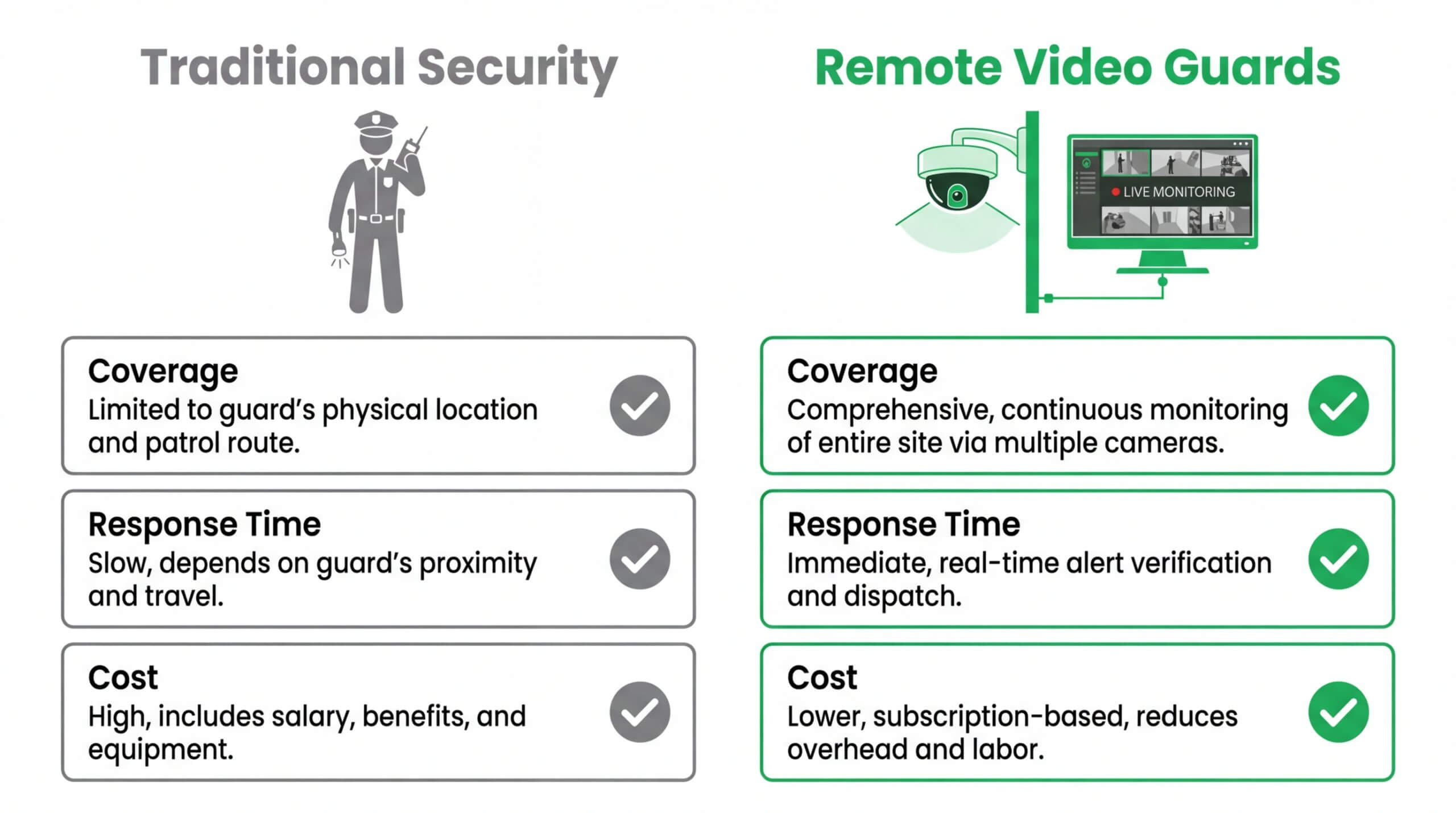
Remote video guards are more effective than traditional security for retail because they combine real-time human intervention with AI-powered detection at a fraction of the cost. The following comparisons break down how remote guards outperform on-site officers, passive CCTV, and alarm-only systems.
How Do Remote Guards Compare to On-Site Security Officers?
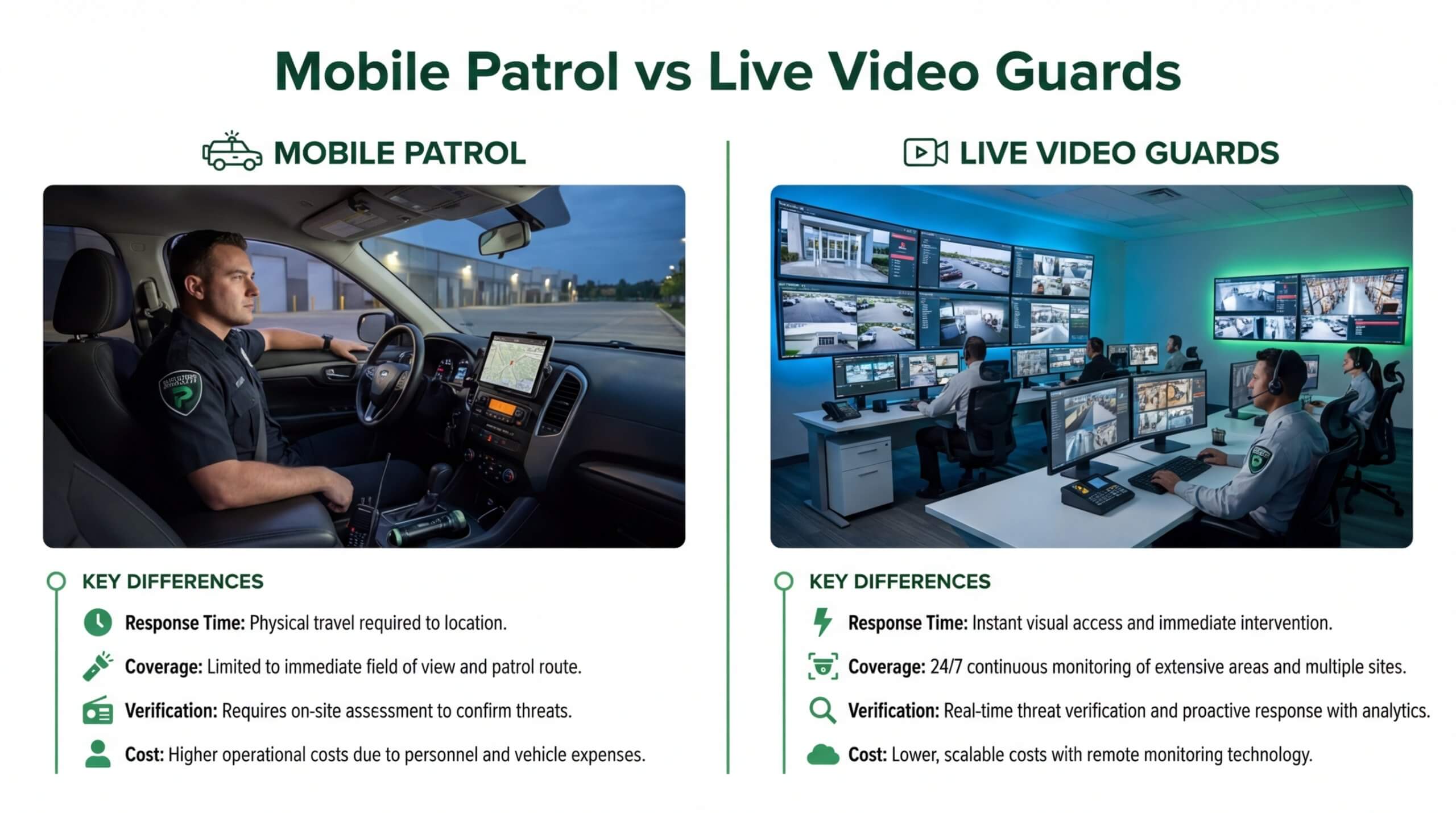
Remote guards compare to on-site security officers by delivering continuous, multi-zone coverage without the staffing limitations and costs of physical personnel. A single on-site guard can only monitor one area at a time, while a remote video guard watches multiple camera feeds simultaneously across an entire facility.
The cost difference is substantial. According to Get SCW, a single 12-hour guard post can cost $65,000 to $219,000 per year, with 24/7 coverage reaching $131,000 to $438,000 annually. Remote monitoring replaces multiple guard posts with centralized surveillance at significantly lower expense.
On-site officers do provide a visible physical deterrent, and that matters. However, remote guards equipped with two-way audio and strobe activation achieve real-time intervention without placing a person in potentially dangerous confrontations.
How Do Remote Guards Compare to Passive CCTV Systems?
Remote guards compare to passive CCTV systems by adding live human decision-making to video surveillance. Passive CCTV records footage for later review; it cannot intervene during an active theft or security breach.
Most retail locations retain security footage for around 30 days, with larger chains holding recordings up to 90 days, according to Mobile Video Guard. That footage only helps after losses have already occurred. By contrast, remote video guards monitor feeds in real time, identify threats through AI-powered alerts, and issue voice-down commands the moment suspicious activity is detected.
This shift from reactive documentation to proactive intervention is what separates monitored systems from passive cameras. Recorded evidence supports investigations, but it does nothing to stop shrink in the moment.
How Do Remote Guards Compare to Alarm-Only Systems?
Remote guards compare to alarm-only systems by providing verified threat assessment before escalation. Traditional alarms trigger a signal when a sensor is tripped, but they cannot distinguish between a genuine break-in and a false activation. This lack of context leads to delayed police response and alarm fatigue.
According to ASIS International, external theft incidents increased 19 percent in 2024. Alarm-only setups struggle with this rising volume because each activation requires the same dispatch process regardless of severity. Remote video guards verify each alert visually, determine the appropriate response, and escalate only confirmed threats.
This verification capability makes remote monitoring far more efficient for retail environments where false alarms would otherwise consume security resources. With verified incidents, retailers can expect faster law enforcement prioritization when dispatch is genuinely needed.
How Do Remote Video Guards Prevent Shoplifting Before It Happens?
Remote video guards prevent shoplifting before it happens by combining real-time audio intervention, visible monitoring presence, and early suspicious behavior detection. These three layers create a proactive deterrence system that stops theft at the intent stage.
How Does Real-Time Audio Intervention Deter Active Shoplifters?
Real-time audio intervention deters active shoplifters by delivering immediate voice-down commands through on-site speakers the moment suspicious activity is detected. A live guard watching the camera feed addresses the individual directly, creating an unmistakable sense of being watched and caught. This direct confrontation disrupts the shoplifter’s decision to proceed. According to Interface Systems, stores utilizing voice-down commands have seen over 99.86% of incidents resolved without police dispatch. That resolution rate speaks for itself; live audio intervention is arguably the single most effective real-time deterrent available to retailers today.
How Does Visible Monitoring Discourage Theft Attempts?
Visible monitoring discourages theft attempts by signaling active surveillance before a potential shoplifter even enters the store. Cameras positioned at entrances, aisles, and high-value zones, paired with signage indicating live monitoring, shift the risk calculation for would-be thieves. Unlike passive CCTV, which records but rarely prevents, visible remote guard systems communicate that someone is watching right now. This psychological barrier is often enough to redirect opportunistic theft entirely. For most retail environments, the combination of prominently placed cameras and clear “live monitoring” signage delivers deterrence value that rivals a physical guard presence at a fraction of the cost.
How Do Remote Guards Identify Suspicious Behavior Early?
Remote guards identify suspicious behavior early by using AI-powered analytics that flag unusual patterns such as loitering near high-value merchandise, repeated aisle passes, or concealment movements. According to the Security Industry Association, AI solutions can monitor and respond to events in real time without requiring continuous human intervention. When the system detects an anomaly, it alerts a live guard who evaluates the feed and decides whether to intervene through audio warnings or escalate. This early identification loop catches theft attempts during the planning stage, well before merchandise leaves the shelf.
With proactive detection in place, retailers can also address internal theft risks using similar monitoring strategies.
How Do Remote Video Guards Help Reduce Employee Theft?
Remote video guards help reduce employee theft by providing consistent, unbiased surveillance of internal operations that eliminates the blind spots and complacency traditional methods allow. Continuous monitoring of cash handling, inventory movement, and restricted areas creates accountability that discourages dishonest behavior.
Internal theft often goes undetected because employees understand store routines, camera angles, and staffing gaps. Remote video guards counter this advantage through 24/7 live monitoring from off-site professionals who have no personal relationships with staff members. This independence removes the social dynamics that sometimes prevent on-site managers from enforcing loss prevention protocols consistently.
According to Embroker, employees steal an average of $1,890 from retailers, while only 10.9% of retail theft losses are typically recovered. These figures highlight why passive recording alone falls short; by the time footage is reviewed, the damage is done and recovery is unlikely.
Remote guards actively watch high-risk activities in real time, such as:
- Cash register transactions and void patterns
- Stockroom access during off-peak hours
- Loading dock deliveries and outbound shipments
- After-hours employee movement in restricted zones
When a remote guard observes suspicious behavior, they can issue an immediate voice-down warning through two-way audio speakers, alerting the individual that they are being watched. This real-time intervention capability transforms surveillance from a forensic tool into an active deterrent. Employees who know that trained, off-site professionals are monitoring their actions at unpredictable intervals are far less likely to attempt theft in the first place.
The psychological impact should not be underestimated. Unlike a wall-mounted camera that employees learn to ignore over time, a live human presence behind the lens changes the risk calculus entirely. For most retailers, addressing internal shrink with this level of consistent accountability represents one of the highest-value applications of remote monitoring technology.
With internal theft controls in place, the next challenge is defending against coordinated external threats.
How Do Remote Video Guards Protect Against Organized Retail Crime?
Remote video guards protect against organized retail crime by detecting coordinated theft patterns in real time and intervening before groups can execute large-scale hits. The subsections below cover how these systems disrupt ORC ring coordination, how they counter flash mob tactics, and how recorded footage supports law enforcement investigations.
How Do Remote Video Guards Disrupt ORC Ring Coordination?
Remote video guards disrupt ORC ring coordination by monitoring multiple camera feeds simultaneously, identifying group staging behavior that precedes organized hits. ORC rings typically rely on rehearsed roles: lookouts, distractors, and sweepers who clear shelves in seconds. Live operators watching feeds can recognize when multiple individuals enter in sequence, communicate through gestures, or position themselves near high-value merchandise zones.
Once suspicious coordination is spotted, remote guards issue immediate voice-down warnings through on-site speakers. This direct intervention breaks the element of surprise that ORC rings depend on. According to ASIS International, external theft incidents increased 19 percent in 2024, and cargo or supply chain theft increased for 48 percent of retailers. That escalation makes real-time disruption, rather than after-the-fact review, essential for retailers facing organized threats.
How Do Remote Monitoring Systems Counter Flash Mob Shoplifting Tactics?
Remote monitoring systems counter flash mob shoplifting tactics by providing instant visual detection across all store zones when large groups converge simultaneously. Flash mob theft relies on overwhelming a location’s capacity to respond. AI-powered cameras flag sudden surges in foot traffic or unusual crowd density at entrances, alerting live guards within seconds.
The FBI’s Uniform Crime Reporting Program released a special report on “Reported Flash Mob Shoplifting Incidents: 2020–2024” in December 2025, highlighting the growing scale of this threat. Remote guards can activate sirens, strobes, and two-way audio the moment a mob enters, creating an immediate deterrent that disrupts the group’s speed advantage. This rapid multi-sensory response is something passive CCTV or alarm-only systems simply cannot deliver.
How Does Video Evidence From Remote Guards Support ORC Investigations?
Video evidence from remote guards supports ORC investigations by providing timestamped, high-resolution footage that law enforcement can use to identify repeat offenders and link incidents across multiple locations. ORC rings often target several stores within the same region, and consistent video documentation helps prosecutors build pattern-of-behavior cases.
A 2024 Verisk report found a 14 percent increase in shoplifting between 2023 and 2024 across sampled cities, yet many incidents go unreported. Recorded footage from remote monitoring closes that gap by giving retailers concrete evidence to submit with police reports. For loss prevention teams tracking organized groups, this archive of footage becomes one of the most valuable tools for connecting isolated thefts into prosecutable criminal enterprises.
What Areas of a Retail Store Benefit Most From Remote Video Monitoring?
The areas of a retail store that benefit most from remote video monitoring are high-traffic and high-risk zones, including entrances, self-checkout stations, stockrooms, and parking lots. Each zone presents distinct shrink vulnerabilities.
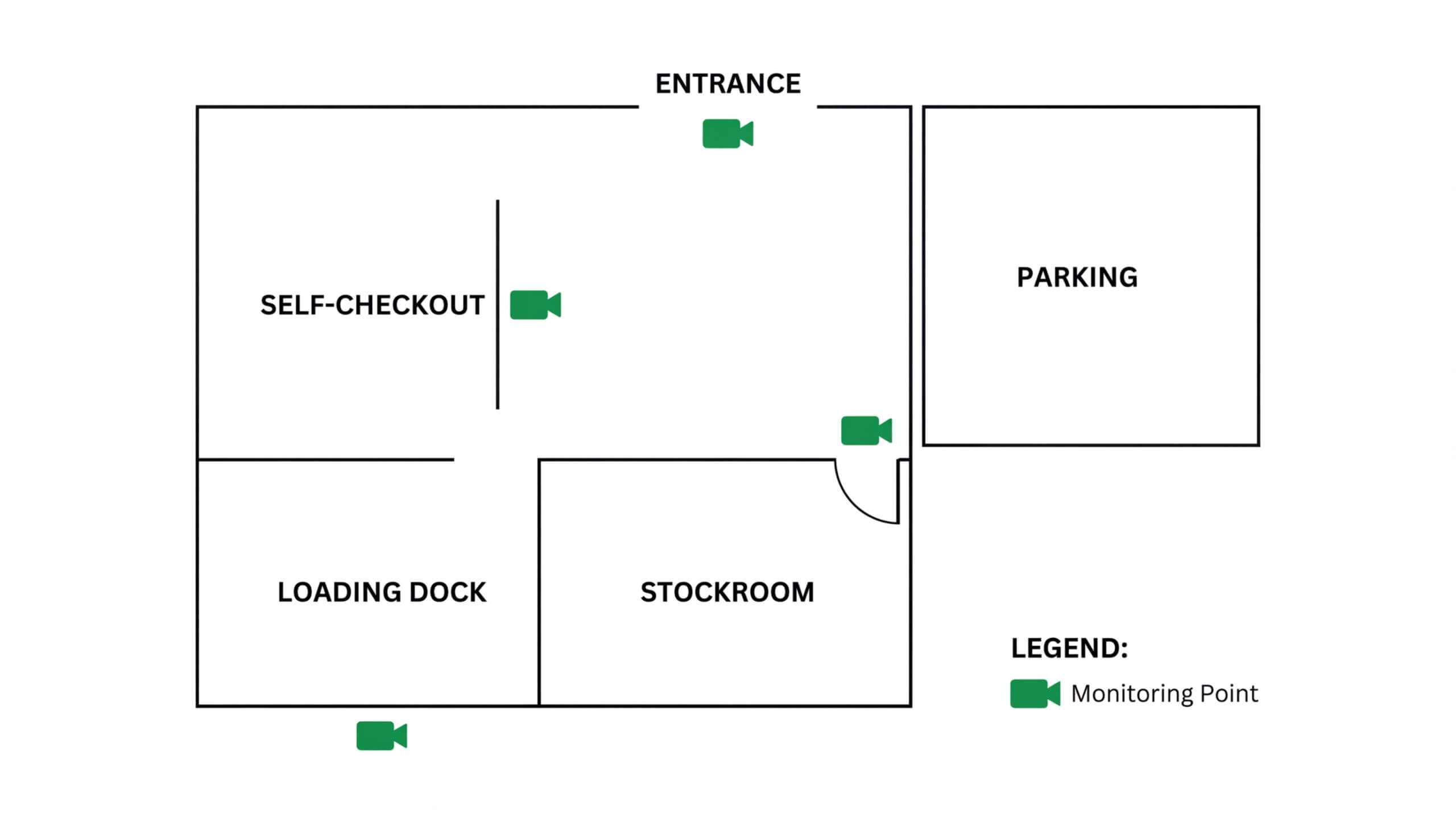
How Do Remote Guards Secure Entrances and Exits?
Remote guards secure entrances and exits by maintaining continuous visual coverage of every person entering and leaving the store. These transition points are where shoplifters conceal merchandise and attempt to walk out unchallenged. Live monitoring operators can track individuals flagged for suspicious behavior, issue real-time audio warnings through integrated speakers, and alert on-site staff before a theft is completed.
Because entrances also serve as the first point of contact, visible camera signage paired with active monitoring creates an immediate psychological deterrent. Most retail places retain this footage for around 30 days, with larger chains storing up to 90 days, ensuring evidence availability for investigations.
How Do Remote Guards Monitor Self-Checkout Stations?
Remote guards monitor self-checkout stations by watching live camera feeds trained on scanning areas, payment terminals, and bagging zones. Self-checkout creates a significant shrink vulnerability because customers control the scanning process themselves. According to a Blue Book Services analysis, self-checkout machines show a shrink rate of 3.5% compared to just 0.21% for conventional cashier lanes.
Remote operators can detect common tactics like skip-scanning, ticket switching, and pass-arounds in real time. When suspicious activity appears, guards issue audio prompts or notify floor staff immediately. This level of oversight is difficult to replicate with passive CCTV alone, making live monitoring one of the most effective countermeasures for self-checkout loss.
How Do Remote Guards Protect Stockrooms and Receiving Docks?
Remote guards protect stockrooms and receiving docks by monitoring camera feeds at access points where inventory is most vulnerable to internal theft and vendor fraud. These back-of-house areas often lack the foot traffic that naturally deters theft on the sales floor, creating blind spots that employees or delivery personnel can exploit.
Live operators verify that deliveries match scheduled appointments, flag unauthorized access attempts, and watch for merchandise being moved toward unauthorized exits. Receiving docks are particularly high-risk because goods transition between carrier custody and store inventory, and discrepancies at this stage often go undetected without visual verification. Consistent remote oversight closes these gaps without requiring dedicated on-site personnel at every loading bay.
How Do Remote Guards Cover Parking Lots After Hours?
Remote guards cover parking lots after hours by using AI-powered cameras to detect motion, loitering, and unauthorized vehicle activity across the entire lot. Parking areas represent one of the most dangerous zones in retail environments. According to data compiled by Tony Donofrio, 53% of those killed in retail-related incidents in 2022 were in parking lots, compared to 43% inside stores.
After closing, these areas become targets for vehicle break-ins, cargo theft, and vandalism. Remote operators can activate sirens, strobes, and two-way audio to confront trespassers before damage occurs. This proactive approach resolves most incidents without requiring police dispatch.
With store zones secured, the next consideration is what return on investment retailers can expect from these services.
What ROI Can Retailers Expect From Remote Video Guard Services?
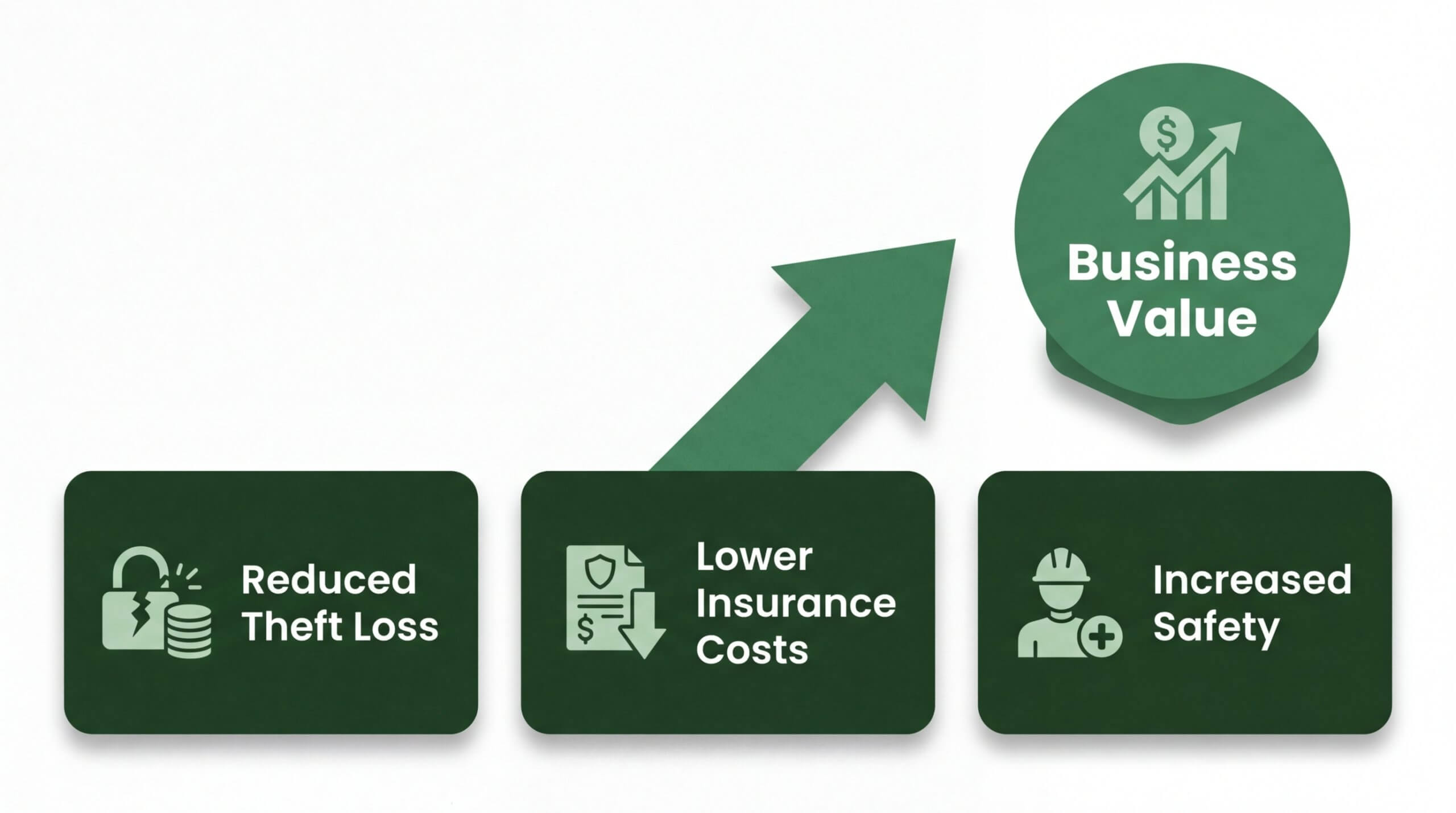
Retailers can expect significant ROI from remote video guard services through lower security costs and measurable shrink reduction. The savings and timeline depend on current security spending and store risk profile.
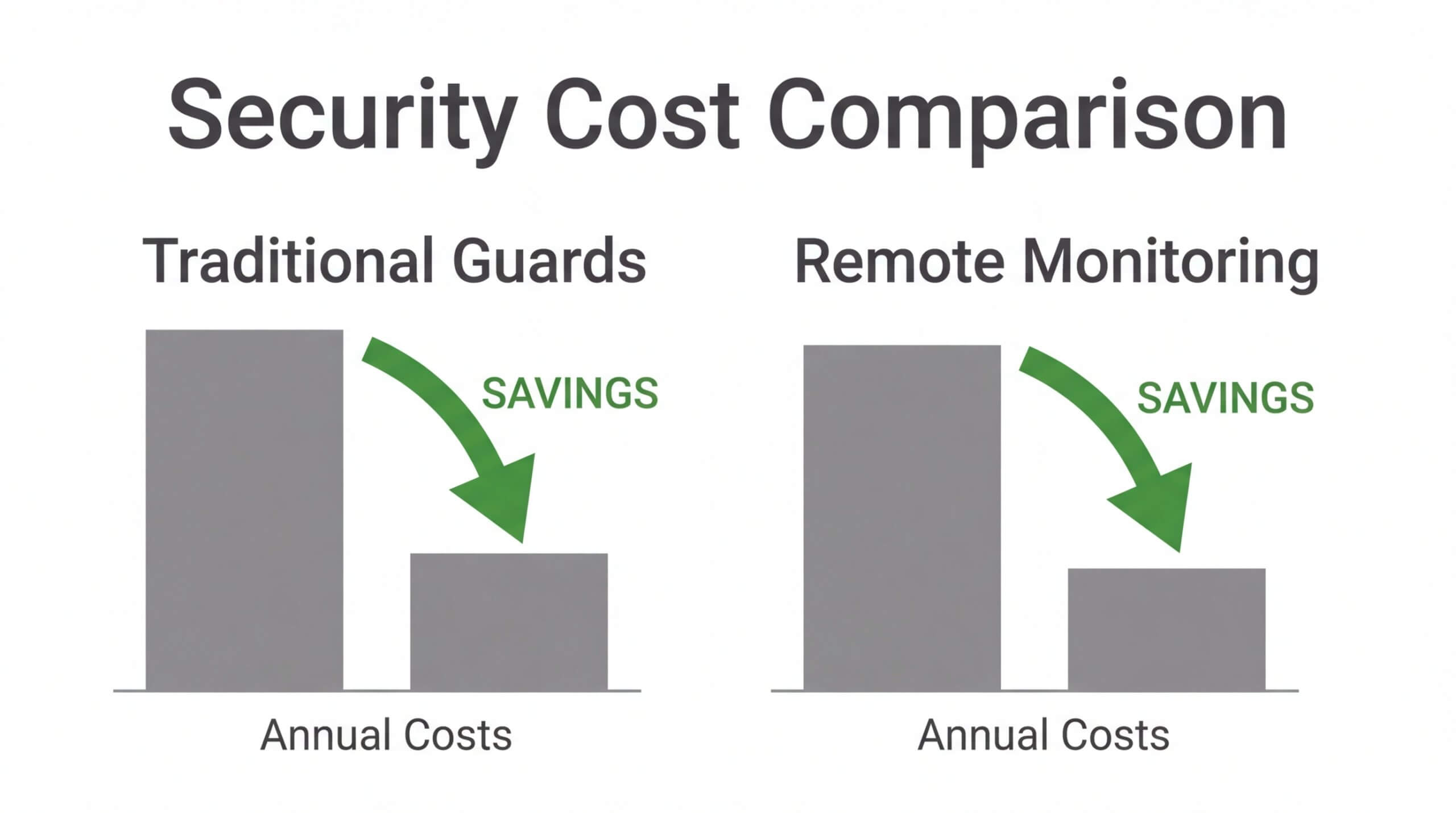
How Much Can Remote Monitoring Save Compared to On-Site Guards?
Remote monitoring can save retailers a substantial portion of their annual security budget when replacing traditional guard posts. A single 12-hour on-site guard post costs between $65,000 and $219,000 per year, according to a 2026 cost analysis from Get SCW. Scaling that to 24/7 coverage pushes the range to $131,000 to $438,000 annually per location.
Remote video guard systems cover the same hours at a fraction of that cost because one trained operator monitors multiple camera feeds simultaneously, aided by AI-powered detection. For multi-location retailers, this cost differential compounds quickly. Reinvesting even a portion of those savings into additional camera coverage or AI analytics often strengthens loss prevention further than simply adding guard hours ever could.
How Quickly Do Retailers See Shrink Reduction After Deployment?
Retailers typically see shrink reduction within the first 30 to 90 days after deploying remote video guards. The initial drop comes from visible deterrence: branded cameras, signage, and real-time audio warnings signal active surveillance to would-be offenders. Stores utilizing voice-down commands have seen over 99.86% of incidents resolved without police dispatch, according to Interface Systems.
This rapid incident resolution means fewer completed thefts from day one. Internal shrink from employee theft also declines once staff recognize that monitored zones now include stockrooms, receiving docks, and POS areas. The steepest ROI gains often appear within the first quarter, with continued improvement as AI detection algorithms learn site-specific traffic patterns.
With clear cost savings and fast shrink reduction established, the next consideration is how remote video guards connect with security infrastructure already in place.
How Do Remote Video Guards Integrate With Existing Retail Security Systems?
Remote video guards integrate with existing retail security systems by connecting to a store’s current cameras, alarms, access control panels, and network infrastructure through IP-based protocols. This section covers compatibility with legacy hardware, network requirements, and integration with point-of-sale and access control platforms.
Remote video monitoring platforms connect to existing IP and analog camera systems using standard protocols such as ONVIF and RTSP. Retailers with older analog CCTV can bridge their equipment through IP encoders, which convert analog video feeds into digital streams without requiring full camera replacement. AI-powered PoE hubs, like those used by Pioneer Security with Nvidia GPUs, layer intelligent threat detection on top of the existing camera network. This approach preserves prior hardware investments while adding real-time analytics and live guard response capabilities. For most retailers, the integration process requires minimal infrastructure changes: a stable internet connection with sufficient upload bandwidth, proper network segmentation for security devices, and coordination between the monitoring provider and the store’s IT team.
Integration also extends to access control systems and point-of-sale platforms. Remote guards can receive triggered alerts from door access panels, intrusion sensors, and POS exception reports, correlating transaction data with video footage to flag suspicious activity. This layered approach ties multiple data streams into a single monitoring workflow. According to the Security Industry Association, AI solutions can monitor and respond to events in real time without requiring continuous human intervention, which means existing alarm and sensor inputs become smarter once connected to a remote guarding platform. Retailers should verify that their chosen provider supports open API connections and can work with their specific hardware vendors, ensuring seamless data flow across all security layers.
For retailers already running multi-site operations, centralized integration is particularly valuable. A single remote monitoring command center can oversee dozens of locations through unified dashboards, standardizing incident response protocols across every store. This scalability makes remote video guard integration one of the most practical upgrades a retailer can make without overhauling existing infrastructure. Understanding integration requirements helps retailers evaluate what to prioritize when selecting a provider.
What Should Retailers Look for in a Remote Video Guard Provider?
Retailers should look for a remote video guard provider that combines AI-powered detection, trained human operators, and proven retail experience. Key evaluation criteria include technology capabilities, response protocols, integration flexibility, and compliance standards.
- AI-powered analytics with live operator backup: The provider should use AI detection to flag threats automatically while trained guards verify and respond in real time. Systems relying solely on automation miss nuanced theft behaviors that human judgment catches.
- Real-time voice-down intervention capability: Two-way audio allows remote guards to address suspects directly, which resolves incidents faster than waiting for police dispatch. Providers without live audio intervention offer only passive monitoring.
- Retail-specific monitoring experience: Retail environments present unique challenges across self-checkout stations, stockrooms, parking lots, and entrances. A provider with dedicated retail protocols will cover these high-risk zones more effectively than a generalist security firm.
- Seamless integration with existing security infrastructure: The provider should connect with current CCTV cameras, access control systems, and alarm panels without requiring a full hardware replacement. Compatibility reduces deployment costs and minimizes operational disruption.
- US-based monitoring centers and compliance standards: Data privacy laws vary by state, so the provider must maintain compliant footage retention policies and secure storage. US-based monitoring centers also ensure faster communication and accountability.
- Transparent reporting and incident documentation: Detailed incident logs, video evidence exports, and shrink trend analytics help loss prevention teams measure ROI and refine strategies over time.
For most retailers, the strongest differentiator is whether the provider can intervene proactively rather than simply record footage for after-the-fact review. Understanding how a provider handles integration and compliance sets the stage for evaluating how Pioneer Security delivers these capabilities.
How Can Proactive Live Video Monitoring From Pioneer Security Help Retailers Fight Shrink?
Proactive live video monitoring from Pioneer Security helps retailers fight shrink by combining AI-powered detection with real-time human intervention across every vulnerable zone. The following sections cover how Pioneer Security protects retail locations and the key takeaways for reducing shrink with remote video guards.
Can Pioneer Security’s AI-Powered Remote Video Guards Protect Your Retail Location?
Yes, Pioneer Security’s AI-powered remote video guards can protect your retail location. Pioneer Security uses Nvidia GPU-powered AI hubs paired with 4K/8MP cameras to detect threats in real time, while US-based live video guards intervene through two-way audio before incidents escalate. This proactive approach covers high-risk areas, including parking lots, loading docks, and delivery areas, where shrinkage concentrates most heavily.
Because retail theft events are increasing while reporting to law enforcement remains low, according to a Retail Industry Leaders Association study, having guards who can verify crimes in progress and dispatch police directly becomes a critical advantage. Pioneer Security, a family-owned company operating since 1978, pairs this technology with hands-on service rather than treating retailers as just another account number. For most retail environments, this blend of AI detection speed and human judgment delivers the kind of verified, real-time response that passive camera systems simply cannot match.
What Are the Key Takeaways About Reducing Retail Shrink With Remote Video Guards?
The key takeaways about reducing retail shrink with remote video guards center on proactive intervention, cost efficiency, and comprehensive coverage. The most actionable insights from this article include:
- Remote video guards deter theft before it occurs through real-time voice-down commands, resolving the vast majority of incidents without police dispatch.
- AI-powered monitoring covers blind spots that traditional guards miss, including self-checkout areas, stockrooms, parking lots, and receiving docks.
- Remote guarding delivers significant cost savings compared to staffing on-site security officers around the clock.
- Employee theft and organized retail crime both decrease when staff and would-be offenders know live human guards are watching continuously.
Self-checkout technology remains a growing vulnerability. According to a Deloitte report, supermarkets see about 20 to 25 percent of loss through self-scan and checkout technology, with that figure rising to nearly 40 percent for mobile scan-and-pay systems. Remote video guards offer one of the most practical solutions for monitoring these high-shrink zones without adding friction to the customer experience. Pioneer Security stops crime before it starts; contact Pioneer Security for a free security evaluation to see how live video monitoring fits your retail operation.