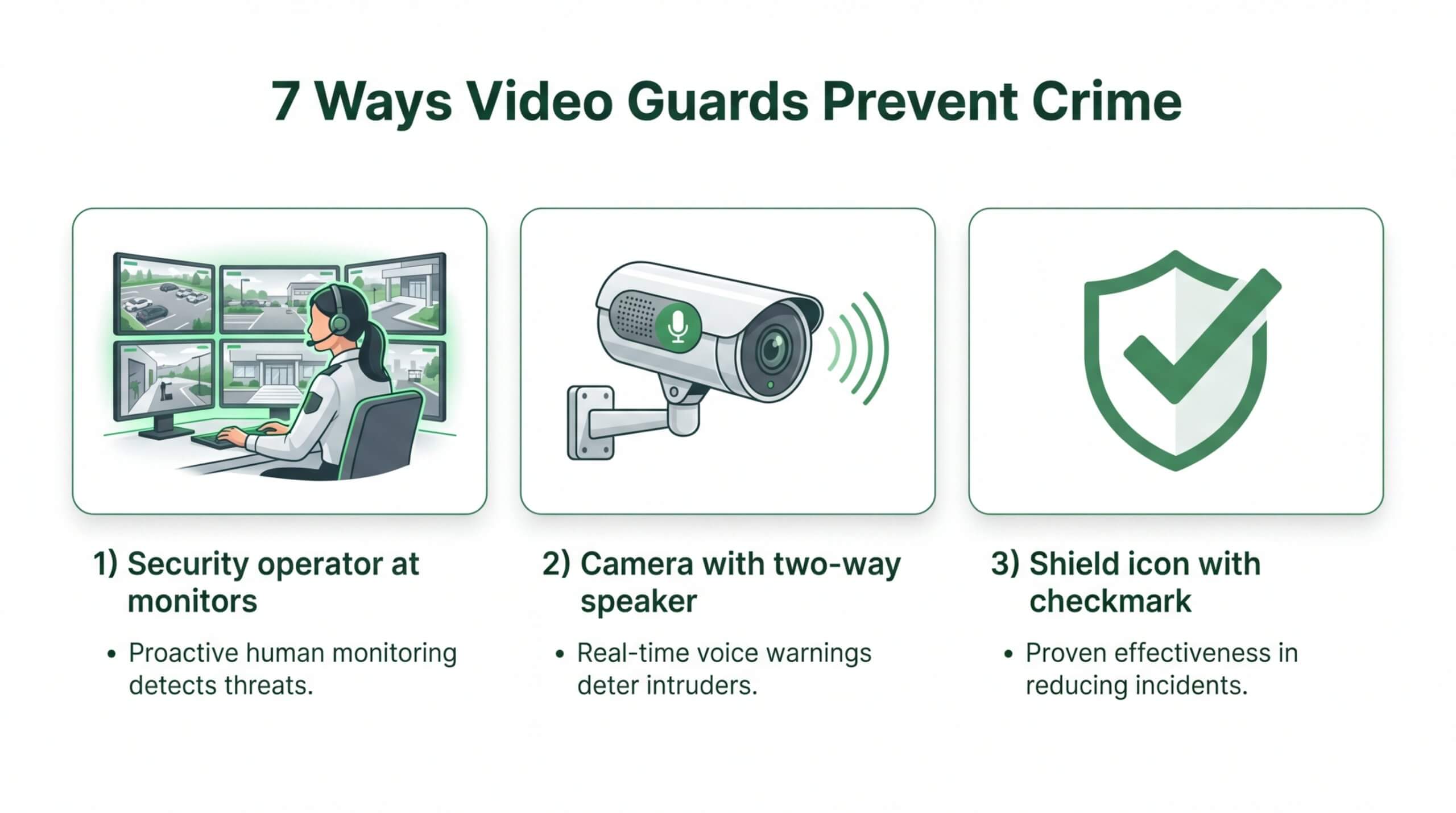
Live video guards are trained security operators who monitor camera feeds in real time and intervene the moment suspicious activity appears, turning passive surveillance into active crime prevention. This guide covers perimeter and access deterrence, internal theft and fraud prevention, property protection for unoccupied sites, package security, disorder-to-crime escalation control, and faster police coordination through verified video dispatch.
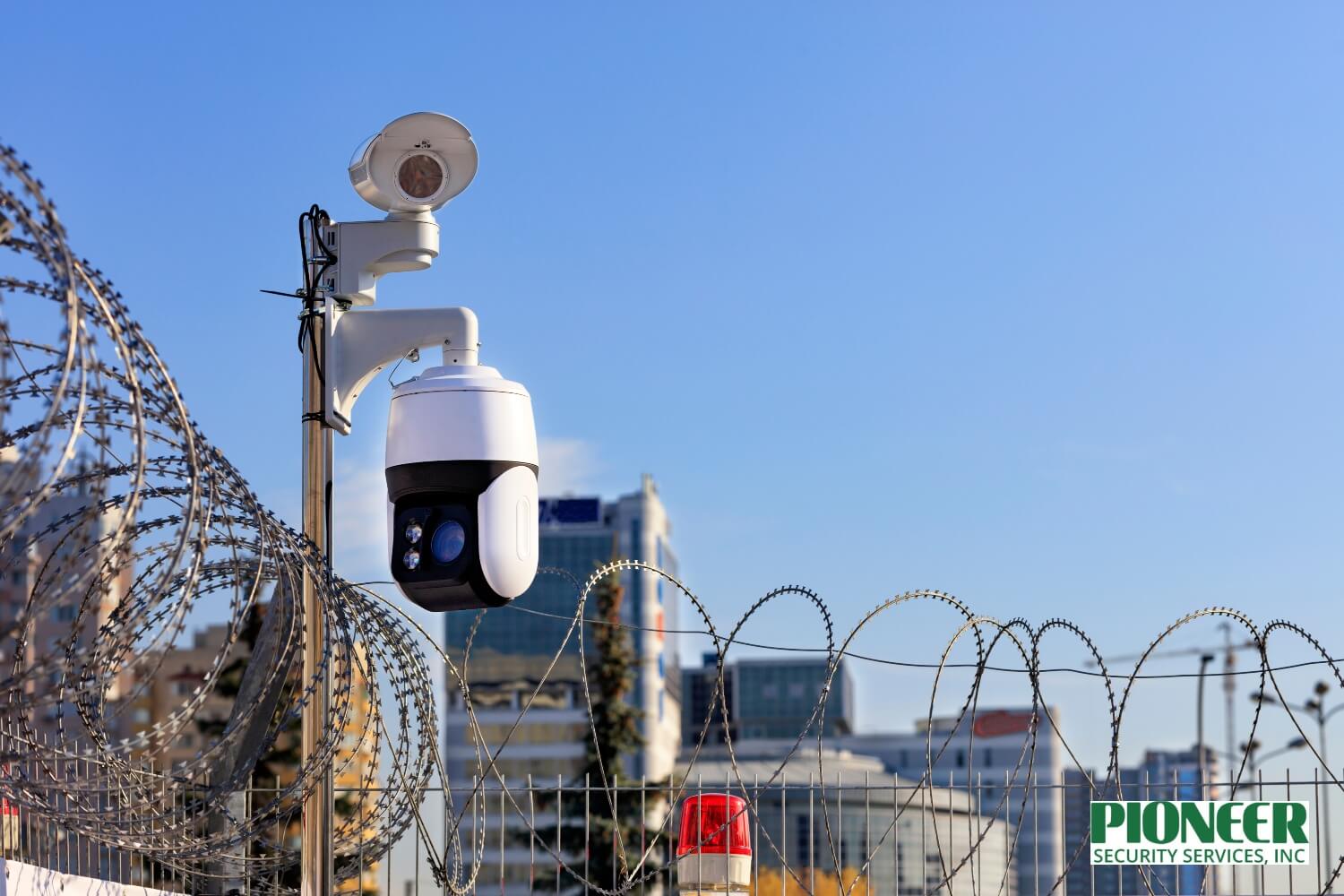
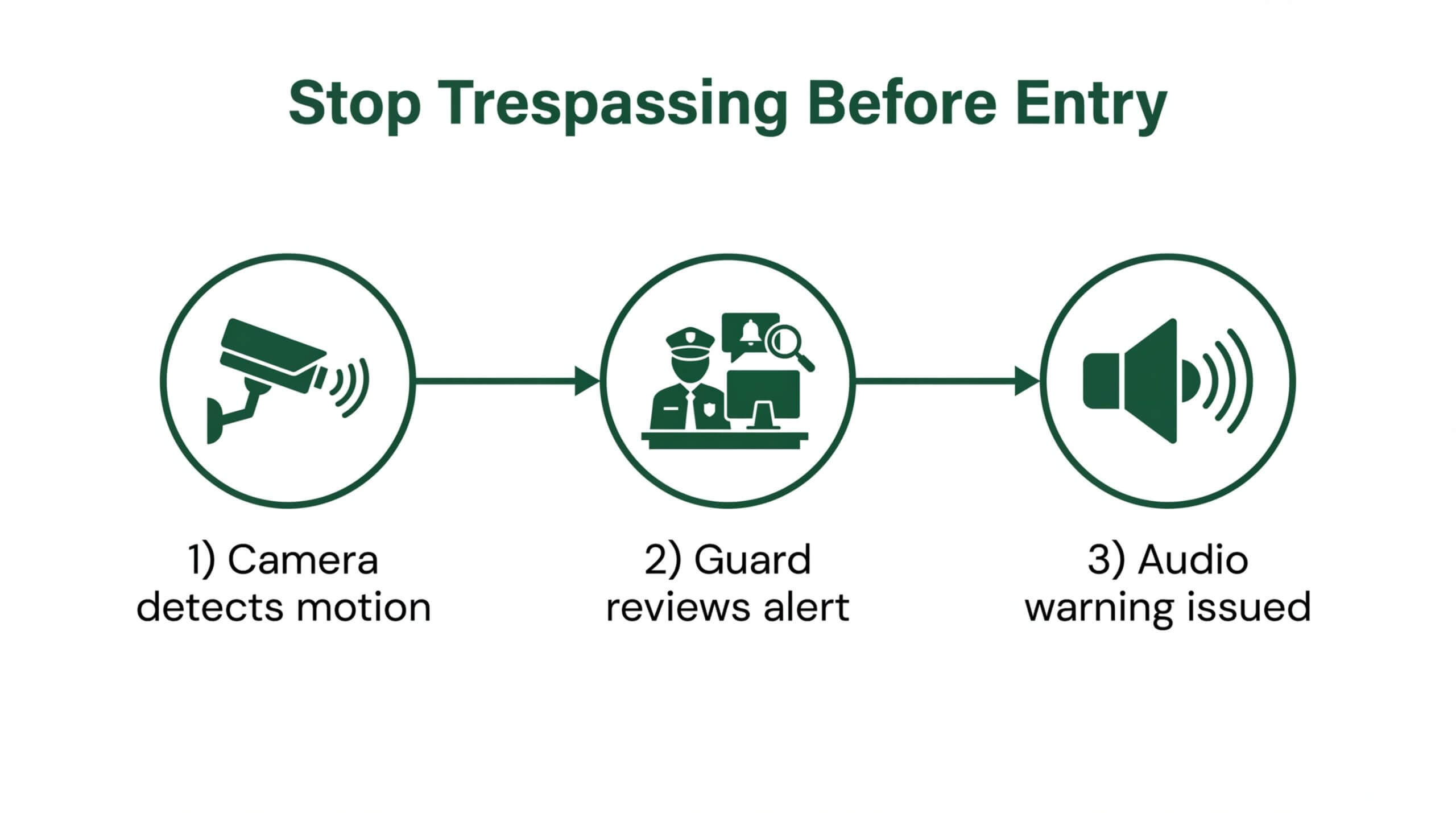
Perimeter deterrence starts before an intruder ever reaches a door. Live video guards detect behavioral cues like gate-testing or after-hours lingering, then deploy two-way audio warnings, sirens, and strobe lights within seconds. That live human voice describing exactly what a trespasser is doing shatters their sense of anonymity and drives most to retreat immediately.
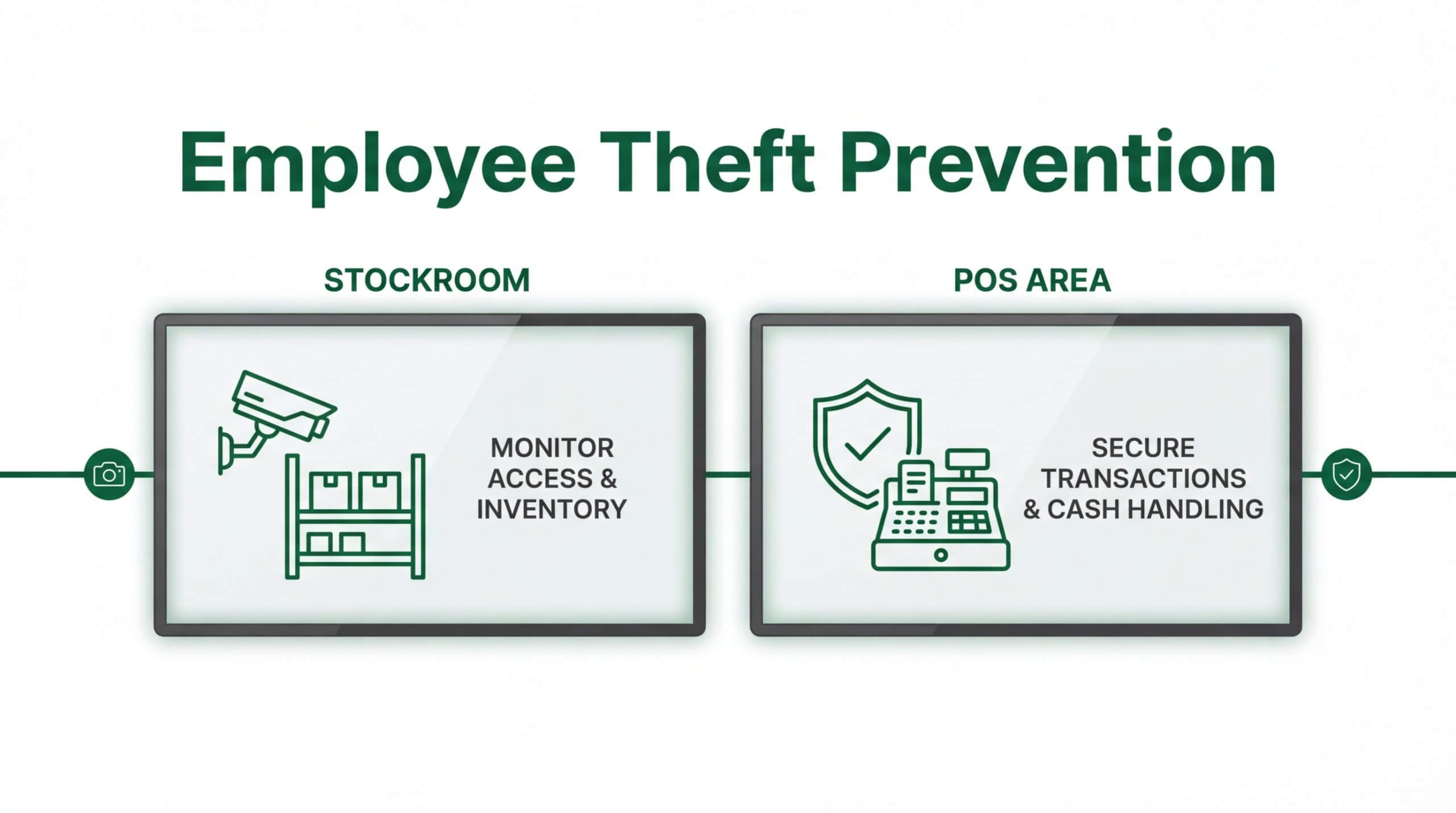
Internal threats are equally targetable. Because live guards monitor stockrooms, loading docks, and point-of-sale zones from an off-site location, they cannot be socially pressured or bribed by staff. Continuous oversight discourages outright theft, time fraud, and unauthorized access across every shift.
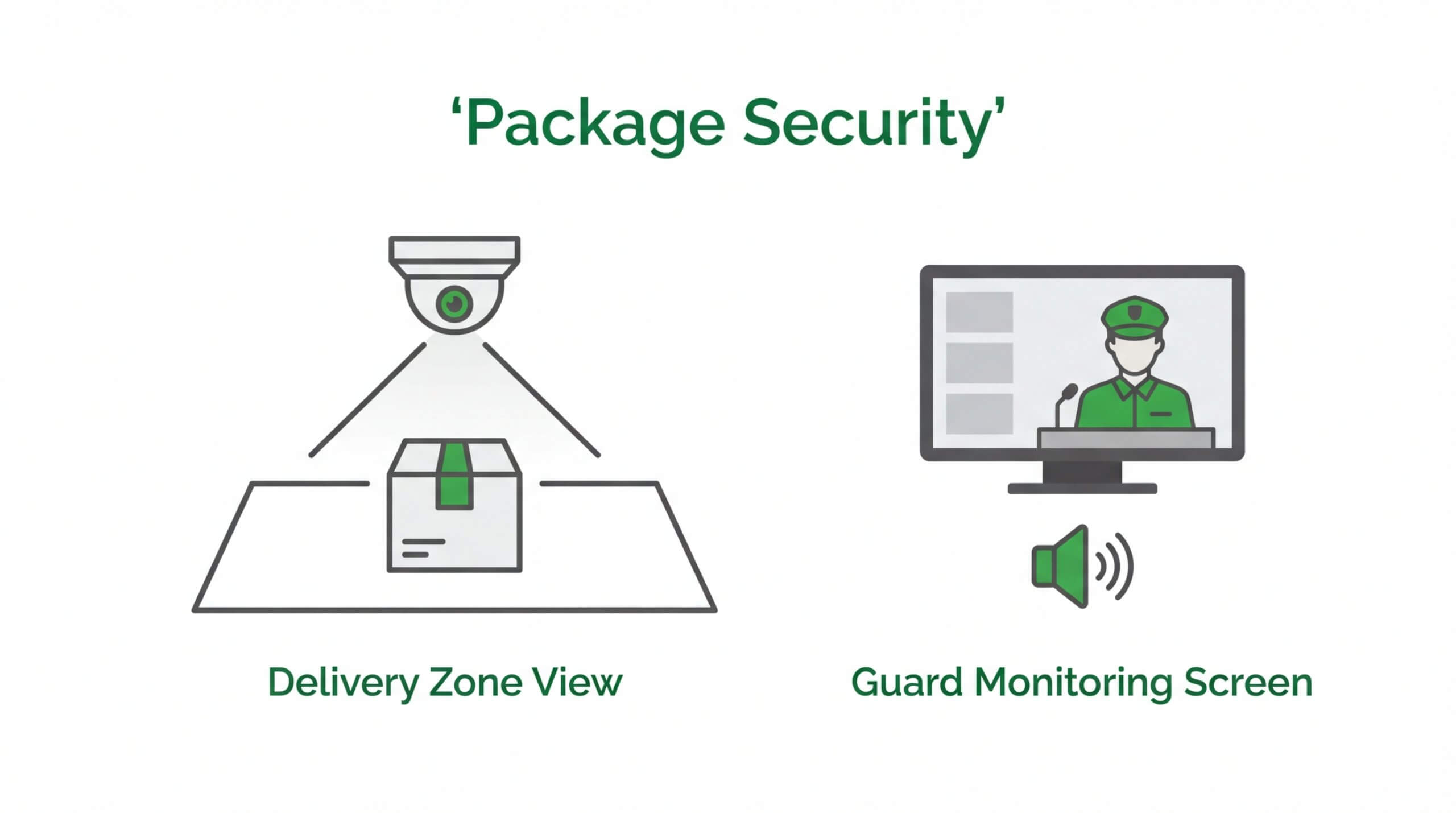
Unoccupied properties, including construction sites, vacant storefronts, and warehouses, attract vandalism precisely because no one appears to be watching. Live guards fill that gap with around-the-clock coverage, issuing real-time audio interventions that stop damage before it escalates. The same monitoring protects delivery zones from package theft by challenging unauthorized individuals on camera the moment they approach.
Liability fraud loses its power when every incident is captured on timestamped, continuously monitored footage. Staged slip-and-fall claims become provably false within minutes rather than months of litigation.
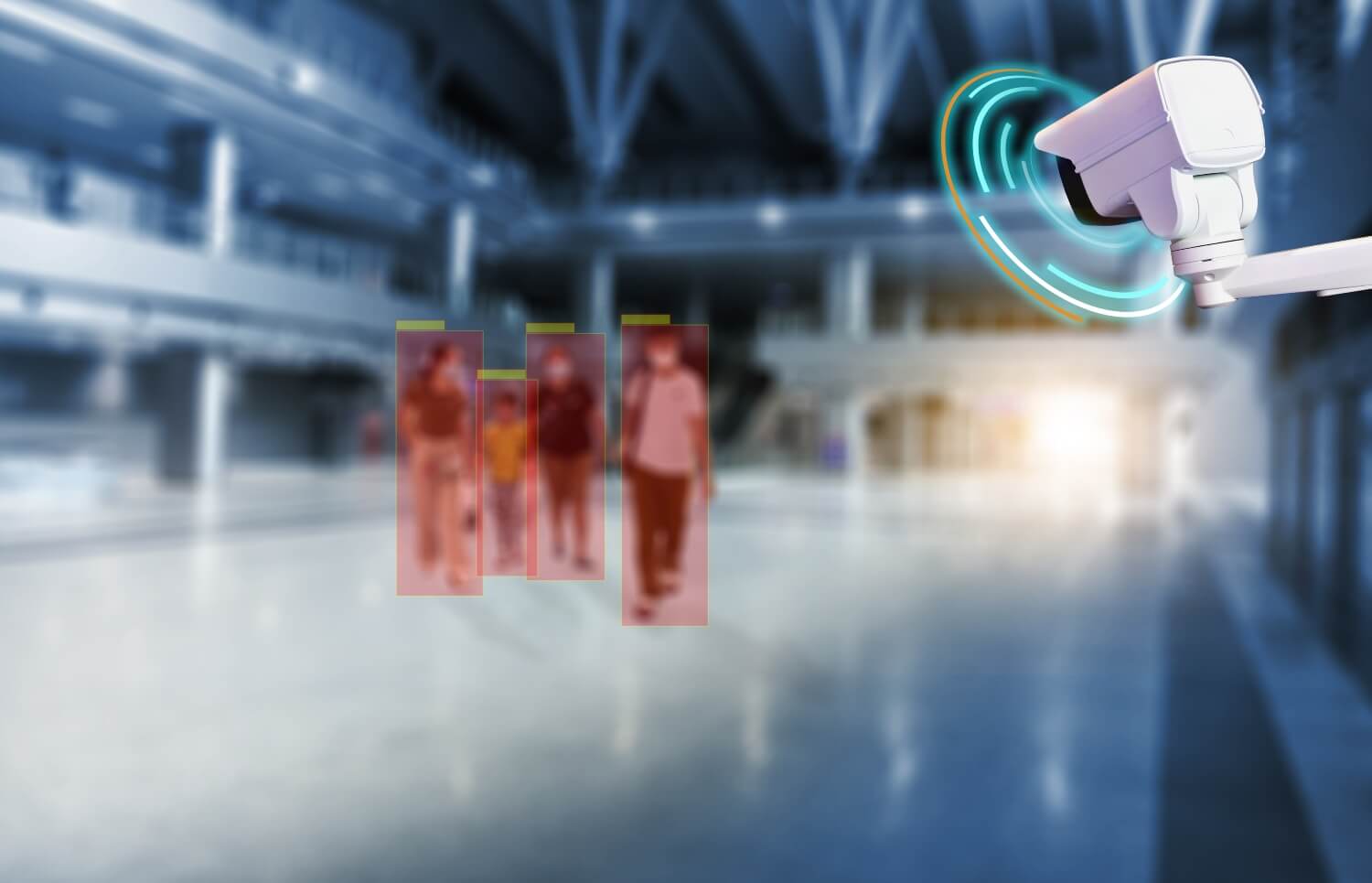
Loitering, a common precursor to serious crime, is detected through AI-powered analytics that flag unusual dwell times while human operators assess context and respond. This hybrid approach catches threats passive alarms miss entirely.
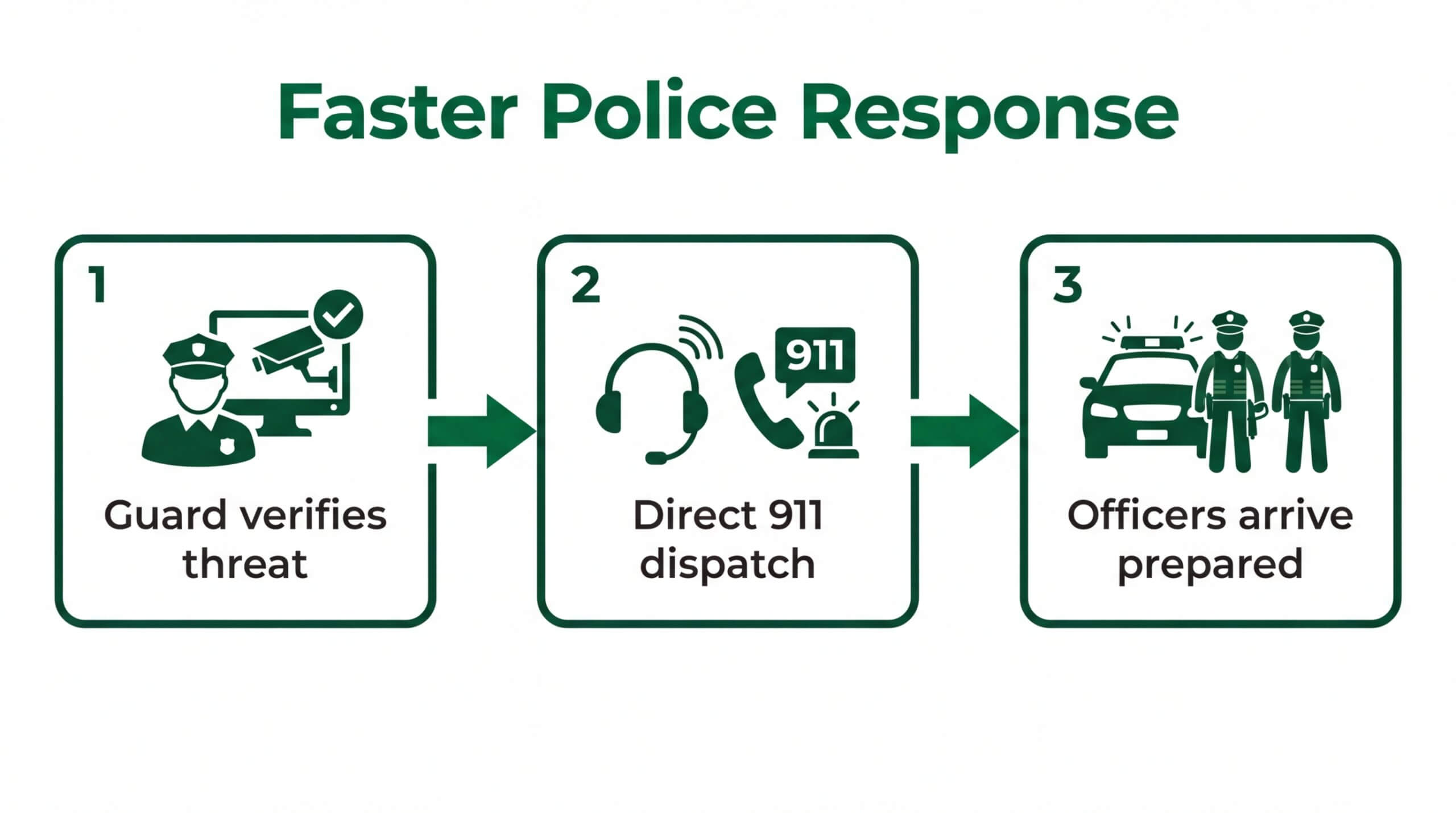
Verified video dispatch transforms police coordination. Instead of sending another unconfirmed alarm signal, live guards relay suspect descriptions, weapon visibility, and movement direction directly to 911, upgrading response priority and giving officers tactical intelligence before they arrive on scene.
How Do Live Video Guards Stop Trespassing Before It Happens?
Live video guards stop trespassing before it happens by combining continuous real-time surveillance with immediate human intervention the moment suspicious activity appears near a property’s perimeter. This proactive approach addresses threats at the earliest stage, well before an intruder breaches a fence line or doorway.
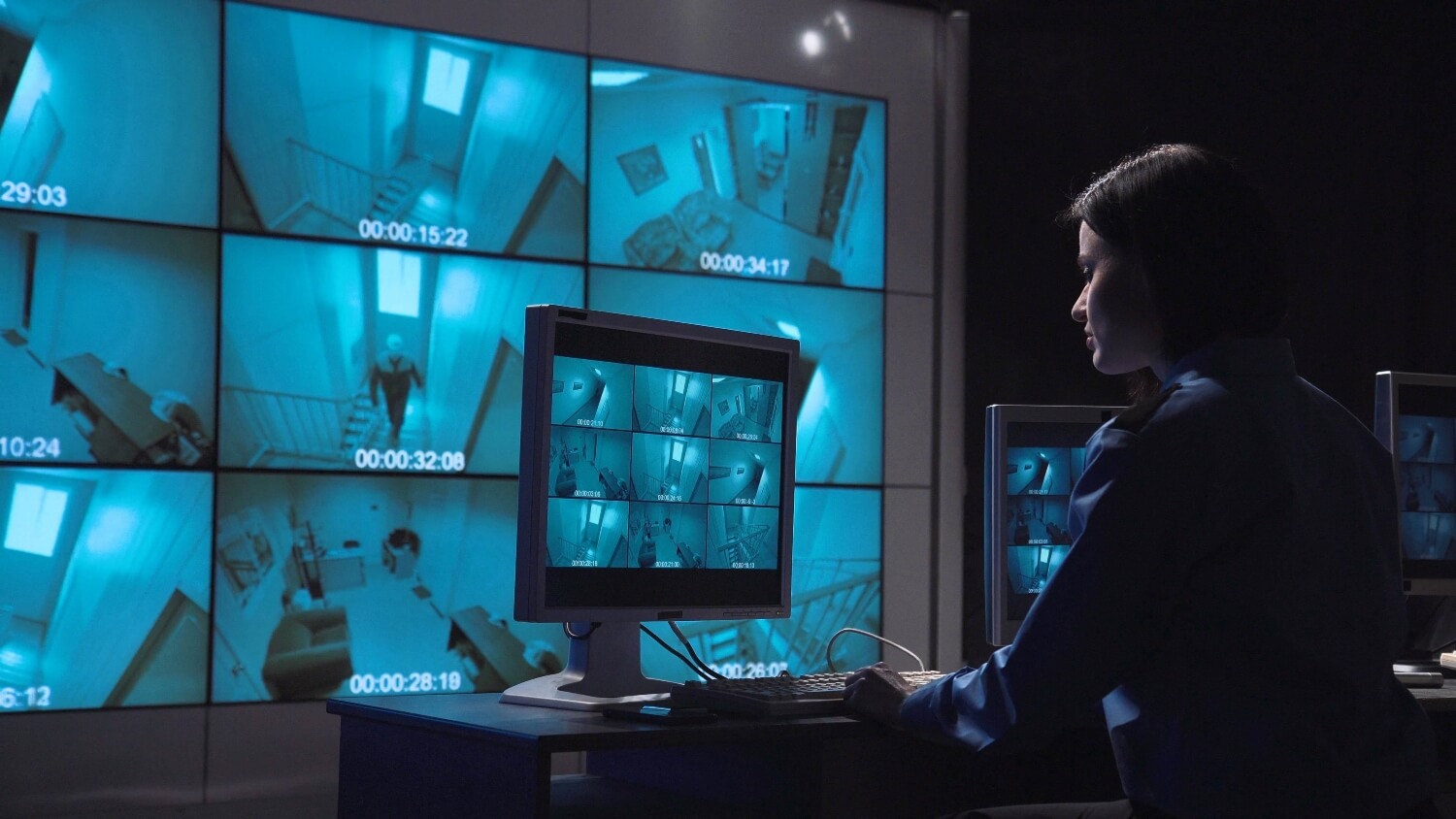
Unlike passive camera systems that simply record footage for later review, live video monitoring places trained security operators behind the screen around the clock. These operators watch for behavioral cues that signal intent: someone testing a gate latch, lingering near a loading dock after hours, or approaching a restricted area with no apparent purpose. When a potential trespasser is identified, the guard can activate two-way audio speakers, trigger sirens and strobe lights, or dispatch law enforcement with a verified description of the threat in progress.
This layered intervention works because it compresses the timeline between detection and response to seconds rather than minutes. According to a 2025 study published by ScienceDirect, a 100 log points increase in per capita camera investment results in a 10% reduction in the crime rate, confirming the statistically significant impact that active surveillance has on deterring criminal behavior.
The psychological effect matters just as much as the technical capability. Trespassers who encounter a live human voice warning them that they are being watched and recorded rarely continue onto the property. Most retreat immediately, because the perceived risk of apprehension jumps dramatically when a real person is clearly monitoring their actions in real time. Visible signage announcing live video guard protection reinforces this deterrent effect even before someone approaches.
For property owners, this pre-entry intervention model eliminates the costly consequences that follow a successful trespass: property damage, liability exposure, stolen materials, and the operational disruption of filing police reports after the fact. Addressing trespassing at the perimeter rather than after entry is, in practice, one of the most cost-effective security investments a commercial property can make. With two-way audio capabilities adding another layer of deterrence, live video guards can escalate their response without any physical presence on site.
How Does Two-Way Audio Deter Criminals in Real Time?
Two-way audio deters criminals in real time by allowing live video guards to issue direct verbal warnings the moment suspicious activity is detected. This immediate human voice response creates psychological pressure that passive alarms cannot replicate, often causing intruders to flee before any damage occurs or entry is attempted.
When a live video guard spots someone approaching a restricted area, they activate two-way audio to deliver a targeted command specific to the person’s actions and location. That level of specificity signals active human observation, which is far more unsettling to a would-be criminal than a generic siren. Most intruders expect recorded messages or automated alerts; hearing a live person describe exactly what they are doing disrupts their sense of anonymity and control.
This capability also serves a critical compliance function. According to Cornell Law School, the Electronic Communications Privacy Act prohibits unauthorized real-time audio surveillance of communications, requiring strict compliance when implementing two-way audio features in security systems. Properly configured systems with visible signage and lawful notification protocols ensure that two-way audio operates within legal boundaries while maintaining its deterrent power.
From a practical standpoint, two-way audio is one of the most underestimated tools in proactive security. A camera alone documents; a speaker alone annoys. Combining both with a trained human operator creates an intervention loop that compresses the gap between detection and response to seconds. For properties that cannot station physical guards around the clock, this real-time verbal engagement bridges the gap between awareness and action, turning surveillance from a passive record into an active defense.
What Unexpected Role Do Live Video Guards Play in Preventing Employee Theft?
Live video guards play an unexpected role in preventing employee theft by serving as a continuous, impartial oversight layer that deters internal dishonesty without requiring on-site management presence. Unlike traditional security cameras that simply record footage for later review, live video guards actively monitor restricted areas, loading docks, stockrooms, and point-of-sale zones in real time. This persistent human observation creates accountability that passive systems cannot replicate.
Employee theft remains one of the most underestimated threats to business profitability. According to a survey published in the International Journal of Retail & Distribution Management, approximately 46% of retail managers cited internal theft as a primary cause of inventory loss. Because colleagues often know camera blind spots and alarm schedules, standard security measures frequently fail to address insider risk. Live video guards counter this advantage; monitored from an off-site location, they cannot be socially pressured, bribed, or manipulated by the employees they observe.
The deterrent effect extends beyond catching theft in progress. When staff know that a trained, US-based guard is watching feeds continuously, the perceived risk of getting caught rises sharply. This psychological shift discourages not only outright stealing but also time theft, unauthorized access to sensitive areas, and inventory manipulation. Two-way audio capabilities allow guards to issue immediate verbal warnings if suspicious behavior is detected, stopping an incident before losses occur.
For businesses dealing with broader internal fraud, the value compounds further. Fraudulent liability claims, falsified timesheets, and unauthorized after-hours access all become more difficult to execute under live surveillance. In many cases, the mere presence of monitored cameras changes workplace culture, reinforcing honest behavior across every shift.
Live video monitoring for employee theft prevention is one of the most cost-effective internal controls a business can implement, often outperforming the expense of hiring additional on-site supervisors while delivering around-the-clock coverage that no single manager can match.
How Do Live Video Guards Reduce Vandalism at Unoccupied Properties?
Live video guards reduce vandalism at unoccupied properties by providing continuous real-time surveillance, immediate audio intervention, and direct police coordination. The following sections cover construction sites, vacant commercial buildings, and warehouses.
How Do Video Guards Prevent Vandalism at Construction Sites?
Video guards prevent vandalism at construction sites by monitoring camera feeds around the clock and issuing live audio warnings the moment unauthorized activity appears. Construction sites are particularly vulnerable because they contain exposed materials, heavy equipment, and lack permanent security infrastructure.
The financial stakes are significant. According to an ASCE Library industry survey, individual respondents reported vandalism losses exceeding $1 million due to property damage and equipment tampering. When a live video guard detects someone approaching a site perimeter after hours, they can activate sirens, issue a verbal warning through two-way audio, and contact law enforcement simultaneously.
This layered response turns a passive camera system into an active deterrent, stopping damage before it escalates.
How Do Video Guards Prevent Vandalism at Vacant Commercial Buildings?
Video guards prevent vandalism at vacant commercial buildings by maintaining active surveillance over properties that would otherwise sit completely unmonitored. Empty storefronts, office spaces, and retail locations attract graffiti, broken windows, and forced entry precisely because no one appears to be watching.
With live video monitoring, a trained guard can identify suspicious behavior in real time, such as someone testing doors or lingering near loading docks. Two-way audio allows direct verbal contact, which often causes individuals to leave immediately. Unlike passive alarm systems that only trigger after a breach, live video guards intervene during the approach phase. For property owners managing multiple vacant units, this proactive coverage reduces repair costs and preserves property value between tenants.
How Do Video Guards Prevent Vandalism at Warehouses After Hours?
Video guards prevent vandalism at warehouses after hours by continuously scanning exterior perimeters, entry points, and parking areas when on-site staff are gone. Warehouses present large, difficult-to-patrol footprints with multiple access points, making them prime targets for vandalism and unauthorized entry overnight.
A live video guard monitoring warehouse cameras can detect threats such as fence breaches, loading dock tampering, or spray-painting in progress. Immediate two-way audio intervention startles offenders, while simultaneous police dispatch ensures a verified response. This combination of human judgment and real-time technology is far more effective than motion-triggered alarms alone, which often generate false alerts that delay genuine responses.
Beyond vandalism, this same monitoring helps detect loitering and other precursor behaviors before they escalate.
Why Are Live Video Guards Effective at Stopping Package Theft?
Live video guards are effective at stopping package theft because they monitor delivery zones in real time and intervene the moment suspicious activity occurs. The scale of the problem, combined with the limitations of passive cameras, makes active human monitoring essential.
Package theft poses a significant challenge for the logistics industry in the United States. According to a 2025 USPS Office of Inspector General report, at least 58 million packages were reported stolen that year alone. Traditional security cameras record theft after it happens, providing footage but no prevention. Live video guards change this dynamic entirely.
When a delivery arrives, a live video guard can visually confirm the drop-off location and continue monitoring until the package is retrieved. If an unauthorized person approaches, the guard issues a real-time verbal warning through two-way audio speakers, creating an immediate deterrent that static cameras cannot replicate. This active intervention disrupts the opportunistic pattern most porch pirates rely on.
For commercial properties receiving frequent shipments, the value compounds. Live video guards track delivery schedules, verify driver credentials, and flag unusual activity around loading docks or mailrooms before theft occurs. Unlike motion-activated alerts that generate notifications without context, a trained guard distinguishes between a legitimate courier and someone casing packages.
The combination of continuous visual coverage and instant human judgment makes live video monitoring one of the most practical defenses against package theft, particularly for properties where deliveries sit unattended for extended periods. Businesses investing in proactive crime prevention should consider how this approach fits within a broader security strategy.
How Do Live Video Guards Prevent Liability Fraud on Your Property?
Live video guards prevent liability fraud by providing continuous, timestamped video evidence that documents exactly what happens on your property. This real-time surveillance captures staged incidents, exaggerated claims, and fabricated injuries before they become costly legal disputes.
Fraudulent liability claims cost property owners thousands in settlements each year, often because there is no objective evidence to dispute a claimant’s version of events. Live video monitoring eliminates this vulnerability. When cameras record every angle of a property 24/7, with trained guards watching in real time, fraudsters lose the anonymity and ambiguity they rely on.
According to a report referencing the Association of Certified Fraud Examiners, internal fraud, including employee theft and fraudulent liability claims, remains a primary challenge for organizations, with nonprofits alone representing 9% of global fraud cases. Commercial properties face similar exposure, particularly in high-traffic areas where slip-and-fall schemes or staged vehicle incidents are common.
Live video guards add a critical layer beyond passive recording. Because a human operator watches feeds as events unfold, suspicious behavior can be flagged immediately. If someone appears to stage an incident, the guard can:
- Activate two-way audio to announce the area is under live surveillance.
- Timestamp and bookmark footage for immediate legal retrieval.
- Alert property management before a fraudulent claim is even filed.
- Provide verified witness documentation to insurance adjusters.
This proactive approach shifts the burden of proof. Instead of relying on after-the-fact investigations, property owners possess real-time, unedited footage that either confirms or disproves a claim within minutes. For property managers weighing the cost of live monitoring against potential litigation expenses, the math strongly favors prevention; a single fraudulent settlement can exceed years of monitoring fees.
With liability fraud addressed through continuous documentation, the next layer of unexpected crime prevention involves detecting early-stage criminal behavior like loitering.
Can Live Video Guards Detect and Prevent Loitering That Leads to Crime?
Yes, live video guards can detect and prevent loitering that leads to crime by identifying prolonged, suspicious presence on a property and intervening before criminal activity escalates. This section covers how addressing disorder early reduces serious crime, how AI-human hybrid systems improve detection, and why electronic surveillance strengthens enforcement.
Loitering often serves as a precursor to more serious offenses, including vandalism, drug activity, and theft. When individuals linger in parking lots, near building entrances, or along perimeters without clear purpose, trained video guards recognize these behavioral patterns in real time. Rather than waiting for a crime to occur, they issue verbal warnings through two-way audio speakers, activate deterrent lighting, or alert local authorities with verified visual evidence.
According to a review published by Wiley Online Library, policing disorder strategies that address social and physical disorder, such as loitering and vandalism, are associated with overall statistically significant reductions in more serious crime types. Live video guards apply this same principle at the property level, treating low-level disorder as an actionable security event rather than a nuisance to ignore.
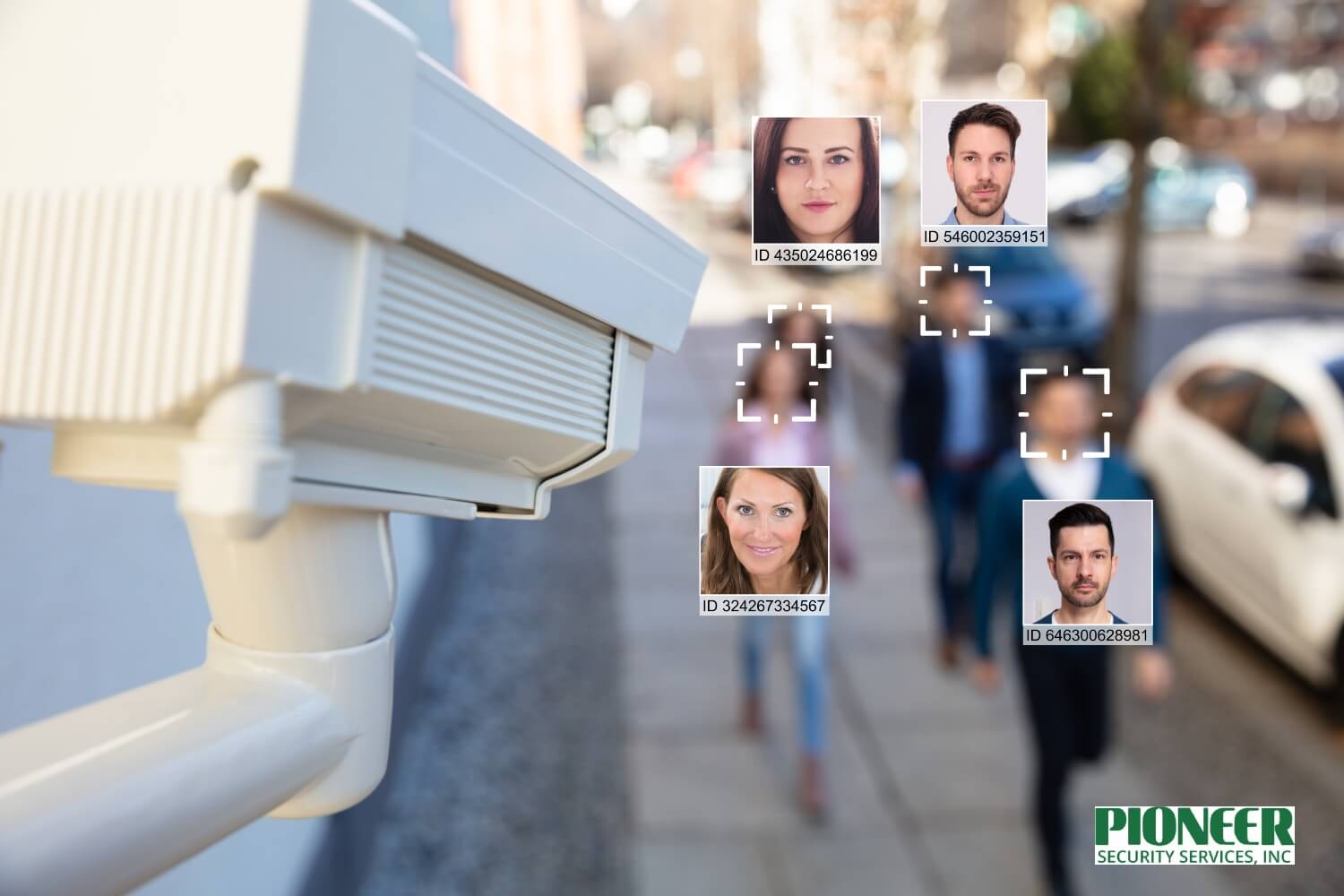
The detection side benefits from AI-powered analytics working alongside human operators. A 2024 study published in Nature Scientific Reports found that hybrid AI-based frameworks combining machine learning for anomaly detection with human expertise in monitoring offer a more robust security solution than either system operating independently. AI flags unusual loitering patterns, dwell times, and movement anomalies; human guards then assess context and decide on the appropriate response.
This layered approach is particularly effective because loitering behavior does not always trigger traditional alarm systems. A person standing near a fence for 20 minutes will not set off a motion sensor designed for intrusion detection. However, AI analytics can identify that extended dwell time as anomalous, prompting a live guard to investigate visually and take action before the situation escalates.
From an enforcement perspective, the United Nations Office on Drugs and Crime emphasizes that electronic surveillance is a critical tool in detecting and prosecuting organized crime across international borders. While most loitering scenarios involve far less severity, the underlying principle holds: documented video evidence of pre-criminal behavior strengthens both immediate intervention and any subsequent legal proceedings.
For property owners, this capability fills a gap that neither passive cameras nor periodic security patrols can address. Recorded footage only helps after a crime has occurred, and patrol guards cannot watch every corner simultaneously. Live video guards maintain continuous visual coverage, turning loitering from an overlooked warning sign into an opportunity for proactive crime prevention.
How Do Live Video Guards Coordinate With Police Faster Than Alarms?
Live video guards coordinate with police faster than alarms by providing real-time visual verification of threats, eliminating the delay caused by unconfirmed alarm signals. According to the ASU Center for Problem-Oriented Policing, the false alarm rate for commercial alarm users is estimated to be as much as three times higher than for residential users, contributing to millions of false activations police respond to annually. This flood of unverified calls trains dispatchers to deprioritize alarm-only signals. The sections below explain how verified video changes police response priority and how live footage prepares officers before arrival.
How Does Real-Time Verification Improve Police Response Priority?
Real-time verification improves police response priority by confirming an actual crime in progress before dispatch is contacted. Many jurisdictions now enforce Verified Response policies, where police respond only if a crime is verified by private security or video. These policies, documented in the International Review of Law and Economics, significantly improve police performance and reduce the burden of unverified alarm calls.
When a live video guard witnesses suspicious activity, they confirm the threat visually and relay verified details directly to 911. This transforms the call from a routine alarm notification into a confirmed crime report, which dispatchers categorize at a higher urgency level. According to criminologists cited by Police1, real-time crime centers utilizing video verification produced a 5% increase in solving violent crimes and a 12% increase in solving property crimes.
For property owners dealing with repeated false alarms, this verification step is often the single most effective upgrade available.
How Does Live Video Evidence Help Officers Before They Arrive?
Live video evidence helps officers before they arrive by giving dispatchers and responding units real-time situational details. A live video guard can relay the number of suspects, their physical descriptions, direction of movement, whether weapons are visible, and which entry points are compromised.
This intelligence allows officers to approach strategically rather than entering a situation blind. Patrol units can position vehicles to cut off escape routes, and dispatchers can allocate the appropriate number of responders based on confirmed threat severity. Officers also gain a critical safety advantage; knowing what they face before stepping out of the vehicle reduces risk during the initial approach.
Compared to a standard alarm signal, which provides only a location and alarm zone, live video turns a reactive police response into a coordinated tactical arrival. With faster, better-informed responses in place, proactive monitoring becomes even more valuable when paired with AI-driven detection tools.
How Should You Approach Proactive Crime Prevention With AI-Powered Live Video Monitoring?
You should approach proactive crime prevention with AI-powered live video monitoring by combining intelligent detection technology with trained human operators who intervene in real time. The sections below cover Pioneer Security’s around-the-clock protection and key takeaways from this article.
Can Pioneer Security’s US-Based Live Video Guards Protect Your Property Around the Clock?
Yes, Pioneer Security’s US-based live video guards can protect your property around the clock. Pioneer Security pairs AI-powered PoE hubs with Nvidia GPUs to trained monitoring professionals stationed entirely within the United States, delivering 24/7 real-time surveillance and intervention.
This approach focuses on reducing criminal opportunities at the property level rather than simply recording incidents after they occur. Pioneer Security’s system uses 4K/8MP cameras with two-way audio, sirens, and strobe lights, giving live guards the tools to confront threats the moment AI flags suspicious activity. Because every alert is verified by a human operator before police dispatch, response priority increases and false alarm burden drops. Pioneer Security stops crime before it starts, treating every client like family through a hands-on, proactive protection model built on over 45 years of industry experience.
What Are the Key Takeaways About Unexpected Ways Live Video Guards Prevent Crime?
The key takeaways about unexpected ways live video guards prevent crime center on the range of threats that real-time human monitoring addresses beyond basic intrusion detection.
- Live video guards stop trespassing before entry by combining AI detection with immediate two-way audio warnings.
- Real-time verbal confrontation through speakers deters criminals who would otherwise ignore passive alarms.
- Continuous monitoring reduces employee theft by creating consistent accountability across shifts.
- Active surveillance prevents vandalism at construction sites, vacant buildings, and warehouses after hours.
- Package theft drops significantly when live operators can challenge suspicious behavior on camera in real time.
- Video-verified footage protects property owners from fraudulent liability claims.
- Addressing loitering early disrupts the escalation pattern that leads to more serious crimes.
- Verified video dispatch gives law enforcement confirmed details before officers arrive, improving response quality.
According to a practical guide published by the Urban Institute, public surveillance systems used for crime control are most effective when active monitoring enables real-time detection and coordinated response. Each of these prevention methods reflects a shift from reactive recording to proactive intervention, which is the core advantage AI-powered live video monitoring delivers.